
Top Bank Statement Analysis Platforms in India for 2026
Bank statement analysis has become the backbone of India’s rapidly evolving financial landscape. The Account Aggregator ecosystem has crossed 100 million consents with a staggering 1059% growth in FY 2024-25, facilitating Rs 462 billion in loan disbursements just in H1 FY25.
Plus, we must note that over 2.2 billion financial accounts are now enabled for data sharing, with expectations that 25% of India’s adult population will adopt this system by the end of 2025. On top of that, the Reserve Bank of India’s Digital Lending Directions 2025, released in May, has consolidated regulatory frameworks while mandating enhanced transparency and compliance standards.
For lenders working through this evolving ecosystem, bank statement analysis platforms have become the essential infrastructure that determines both competitive edge and regulatory compliance in lending.
In this article, let’s go over the top bank statement analysis platform options for lenders in 2026.
4 Major Platform Categories for India’s Lending Ecosystem in 2026
India’s lending market diversity means different institutions need different approaches to bank statement analysis solutions:
1. Enterprise Platforms for Large Financial Institutions
Major banks and established NBFCs need comprehensive statement analysis platforms that handle enormous volumes while integrating smoothly with existing loan origination and management systems.
These platforms offer advanced customisation options, multi-tenant architecture, and enterprise-grade security features. They support complex workflows with multiple approval layers and sophisticated risk-scoring mechanisms.
2. Mid-Market Solutions for Regional Lenders
Growing NBFCs and regional financial institutions need platforms that balance functionality with cost-effectiveness. These solutions provide essential statement analysis features without enterprise complexity, offering quick implementation and user-friendly interfaces.
They typically include standard integration capabilities and pre-configured risk assessment models suited for focused lending portfolios.
3. Fintech-Integrated Tools for Digital-Native Lenders
Digital-first lending platforms need API-centric bank statement analysis solutions that integrate smoothly into modern technology stacks. These platforms focus on real-time processing, mobile-optimised dashboards, and cloud-native deployment.
They often include built-in Account Aggregator connectivity and support for emerging data sources beyond traditional bank statements.
4. Comprehensive Analytics Suites
Forward-thinking lenders increasingly want multi-product platforms that analyse bank statements alongside GST returns, credit bureau reports, and other financial data sources.
These comprehensive solutions provide complete borrower assessment capabilities, cross-referencing multiple data points to generate accurate risk profiles and spot inconsistencies across different financial documents.
Essential Bank Statement Analysis Platform Requirements for 2026
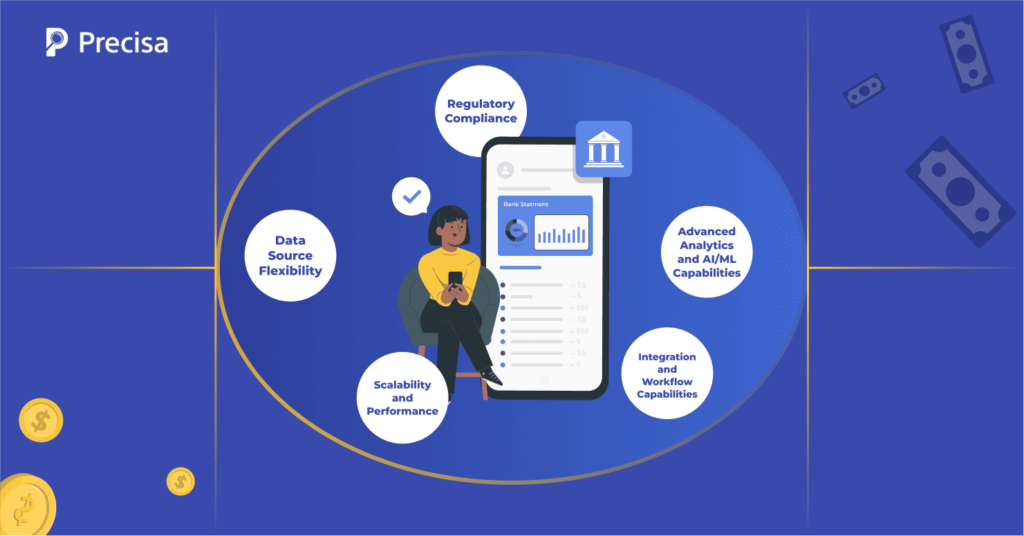
The next generation of bank statement analysis platforms must tackle both technological advancement and regulatory changes, reshaping India’s lending sector. Here are the critical capabilities lenders must evaluate:
1. Regulatory Compliance and Reporting
The RBI’s 2025 Digital Lending Directions require all regulated entities to report Digital Lending Apps through the Centralised Information Management System (CIMS) portal by June 15, 2025. Platforms must ensure data storage on Indian servers, with any offshore processing requiring deletion and restoration within 24 hours.
Bank statement analysis solutions need built-in compliance frameworks that automatically generate audit trails and maintain regulatory adherence without manual work. Essential compliance features include automated regulatory reporting, data encryption both in transit and at rest, role-based access controls, and comprehensive logging.
Moreover, the platform should maintain detailed audit histories for regulatory reviews and internal compliance monitoring.
2. Data Source Flexibility and Account Aggregator Integration
Modern platforms must support multiple data ingestion methods, including manual uploads, API integrations, and Account Aggregator connectivity. The solution should handle various file formats (PDF, Excel, CSV) while maintaining accuracy across different bank statement templates.
The Account Aggregator framework is evolving from basic loan underwriting to comprehensive financial services, including portfolio management and early warning systems. Platforms must integrate AA connectivity seamlessly, enabling real-time data fetching with proper consent management, eliminating document upload delays while ensuring data authenticity.
3. Advanced Analytics and AI/ML Capabilities
Why AI-Powered Bank Statement Analysis Matters
Modern bank statement analysis platforms need sophisticated pattern recognition algorithms that go well beyond basic transaction categorisation. Strong transaction categorisation forms the foundation, automatically classifying transactions into meaningful categories like salary credits, loan EMIs, business expenses, and irregular transactions.
Advanced features include counterparty identification, recurring pattern detection, cash flow analysis, automated calculation of financial ratios, and cash flow forecasting. Fraud detection capabilities should identify document tampering, duplicate transactions, circular transaction identification, and suspicious activity patterns. The platform should use machine learning to continuously improve accuracy in detecting irregularities.
4. Integration and Workflow Capabilities
Smooth integration with existing loan origination systems, customer relationship management platforms, and core banking solutions is crucial for operational efficiency. APIs should enable bi-directional data flow, allowing an automatic population of lending applications with analysis results.
5. Scalability and Performance
Digital lending volumes are scaling rapidly, with the market growing from $9 billion in 2012 to $350 billion in 2023, with the global digital lending market projected to reach $507.27 billion in 2026.
Digital lending volumes are scaling rapidly, with the market growing from $9 billion in 2012 to $110 billion in 2019. Platforms must handle massive transaction volumes without performance issues.
Cloud-native architecture, parallel processing capabilities, and efficient database management become critical for institutions processing thousands of statements monthly.
6. Reporting and Insight Generation
Effective platforms generate actionable insights through intuitive dashboards and customisable reports. Visual representations of cash flows, transaction patterns, and risk indicators help lending teams make quick, informed decisions.
Export capabilities should support various formats for further analysis or regulatory submissions. Advanced platforms offer predictive analytics highlighting potential future risks based on historical transaction patterns.
Takeaway
As India’s digital lending landscape grows, smart bank statement analysis platforms are no longer optional—they’re essential.
While numerous solutions serve the Indian market, Precisa has emerged as the comprehensive platform of choice for institutions seeking future-ready bank statement analysis capabilities.
- Proven Scale and Market Presence: With over 1,000+ clients across 25+ countries, the platform has processed more than 1.5 million bank statements covering 850+ banks and 1,200+ bank statement formats, analysing over 510 million transactions.
- Complete Financial Analytics Suite: Beyond bank statement analysis, Precisa offers integrated GSTR analysis, credit report analysis, and AML monitoring capabilities within a single platform.
- Industry Versatility Beyond Lending: Precisa’s applications extend across the financial services spectrum, supporting insurance underwriting through cash flow analysis, wealth management through comprehensive financial profiling, and forensic investigations through advanced money trail detection.
- Technical Excellence and Innovation: The platform leverages advanced AI and machine learning for irregularities discovery, comprehensive transaction categorisation, and automated counterparty detection. Built-in Account Aggregator connectivity ensures future readiness, while support for scanned statements addresses practical requirements in India’s diverse documentation landscape. Moreover, real-time processing capabilities and transparent pricing models make implementation straightforward for institutions of all sizes.
Book a demo today to learn more!


