
Documents Required for Corporate Loan Approval: A Guide for Lenders
In FY2023-24, banks approved a record-high 944 corporate loans totalling INR 2,90,978 crore, marking a substantial increase from the 547 projects sanctioned in the preceding fiscal year. These numbers show a growing demand for credit as Indian businesses seek expansion opportunities.
Securing a loan can be crucial for corporates, but it requires accurate documentation to prevent potential rejection. For banks and other lenders, approving a corporate loan application requires carefully assessing a company’s financial health, operative stability, repayment capability, and associated risks.
While technology like bank statement analysers has greatly simplified reviewing, success hinges on collecting and assessing the right documents. This is because each piece of paperwork provides critical insights, making it a cornerstone of lenders’ due diligence.
This blog post provides a detailed checklist of the essential documents required for corporate loan approval.
Major Corporate Loan Types Available in India
Corporate loans are generally categorised into the following types based on the business structure and operations:
Secured Business Loan
Loan amounts tend to be higher, requiring borrowers to offer collateral to secure approval. This collateral can include assets such as machinery, real estate, inventory, or other valuable business assets.
On the upside, interest rates are generally lower because the lender faces reduced risk.
Eligibility Terms
- Must be at least 2 – 3 years old
- CIBIL score should be greater than 650
Unsecured Business Loan
These loans are granted based on the borrower’s credit profile and the stability of their business. Unsecured business loans do not necessitate collateral; however, they usually come with higher interest rates and more stringent terms compared to secured business loans.
Eligibility Terms
- Must be at least 2 – 3 years in operations
- Must have a minimum 700 CIBIL score
- Should show consistent profitability
Small Business Loan
Small business loans play a significant role in fostering India’s economic growth and innovation. Companies seek this kind of loan to obtain working capital, invest in technology, develop infrastructure, or enter a new market.
Eligibility Terms
- Must be 2 – 3 years in operations
- Should maintain at least a 650 CIBIL score
- Must qualify as an SME/MSME by the government
MSME Business Loan
The loans are supported by government initiatives like the Pradhan Mantri Mudra Yojana (PMMY). Designed for businesses that fall under the MSME category, the loans are mostly unsecured, with low interest rates and flexible repayment terms.
Eligibility Terms
- Must be at least 3 years in operations
- Must have a 685 or higher CIBIL score
- Must be defined as an MSME by the government
SME Business Loan
The loans are approved for small to medium-sized enterprises in various sectors. Government initiatives generally offer SME business loans, non-banking financial companies (NBFCs), and some banks. Loans can be secured or unsecured corporate loans.
Eligibility Terms
- Must have 650 to 700 CIBIL score
- Must be at least 2 – 3 years in operations
- Must be an SME as defined by the government
Micro Business Loan
The loans are designed for low-income groups, such as individuals starting a home-based business, who do not have access to traditional banking services.
It requires minimal documentation, the loan amount can be from INR 5000 to INR 1 lakh, and it has shorter repayment periods.
Eligibility Terms
- Must be 1 – 2 years in operations
- CIBIL score should be at least 650
- Must be a registered business (basic)
6 Mandatory Documents Required for Corporate Loans
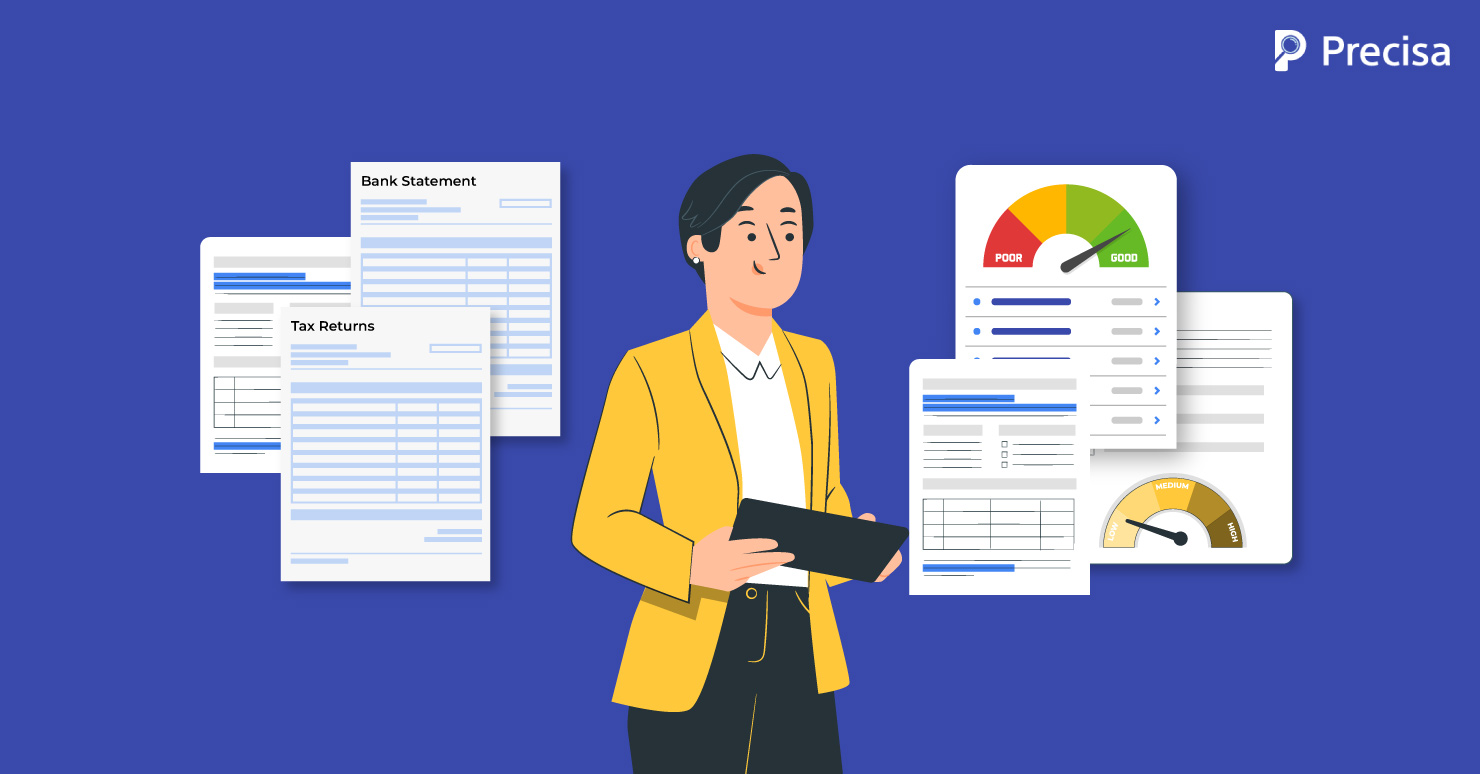
The required documents may vary for corporate loan applications depending on the business type. However, six key documents that help lenders assess borrowers’ eligibility are as follows:
KYC Documents
Lenders use the KYC (Know Your Customer) documents to verify the identity and address of the borrowers and the co-borrowers. It helps reduce the risk of fraud.
Borrowing companies must submit self-attested copies of the following documents:
- Address Proof: Any government-issued document, Aadhar card, passport, business lease agreement, or office utility bills.
- Identity Proof: Aadhar card, passport, PAN card, Driving license, or voter ID.
- PAN Card: To verify tax identification.
Business Plan
A business plan outlines a company’s business objectives, long and short-term goals, expansion plans, development strategies, market analysis, and financial projections in detail.
The document provides lenders with a clear understanding of the business, how the corporate loan will be used, and its potential impact on the company’s growth.
Essential components of a business plan:
- Type of business
- Products and services offered
- Target market
- Competitor analysis
- Marketing Plan
- Financial projections
- Operational plans
- Management structure
- Funding requirements
- Usage of the loan amount
- Repayment plan
Business Registration Documents
Business registration documents help lenders determine the legal status of the borrowing entity and whether it complies with all applicable regulations.
Documents required include:
- Certificate of Incorporation
- Memorandum of Association
- Articles of Association
- Trade license
- GST registration certificate
- Partnership deeds
- MSME registration (if applicable)
- Udyog Aadhar registration (if applicable)
Bank and Financial Statements
Bank statements display a company’s cash inflow and outflow in a particular period. The figures help lenders determine a company’s liquidity and cash reserves. Borrowing companies need to provide:
Last six months’ bank statements from the business’ primary current account.
A financial statement summarises a business’s financial health, enabling lenders to assess the company’s profitability, liquidity, and repayment capacity.
Borrowers must submit the following financial statements for the previous three years:
- Balance Sheet
- Profit and Loss Statement
- Cash Flow Statement
- Tax Audit Report (if applicable)
- Statutory Audit Report (if applicable)
- VAT Returns (in case of provisional financials)
Tax Returns
Tax returns disclose a business’s income, expenses, and tax liabilities for a fiscal year. Financial institutions use the document to assess the company’s income stability and whether it can meet its financial obligations.
Corporates are required to submit income tax return (ITR) files from the previous three years for bank loan approval.
Collateral Documents
Collateral documents are necessary for secured corporate loan approval. The business owner must provide relevant documentation for the collateral, such as:
- Property documents
- Sales deed and title deed
- Company valuation certificates from an accredited valuer
- NOCs from the municipality corporation or relevant authority
- Vehicle title
- Machinery/inventory bills
- Accounts receivables
- Any additional documents depending upon the collateral type
How Precisa Helps Lenders in Corporate Loan Approval
Here’s how Precisa’s intuitive financial data analytical tool helps banks, MSMEs, and NBFCs expedite the corporate loan approval process with its intelligent automation:
- Cross-references bank statement data with GST records for precise financial predictions.
- Automatically segregates transactions into inflow and outflow categories and various subcategories for meticulous evaluation.
- Runs thorough risk assessment using comprehensive data from multiple data sources.
- Generates creditworthiness scores, also known as Precisa and Volatility scores, to make loan approval more accurate.
- Enables lenders to run compliance checks as per RBI guidelines.
- Leverages AI protocols to detect unusual transaction patterns and flag potential fraudulent activities.
- Uses predictive data analytics to forecast a business’ ability to repay loans.
Takeaway
Understanding and preparing the right set of documents is important for both lenders and borrowers in the corporate loan process.
While traditional document verification remains essential, modern tools like Precisa revolutionise how lenders review loan applications. By integrating AL, ML, OCR, and cloud computing, Precisa’s Bank Statement Analysis tool helps banks and financial institutions accelerate the loan approval process from a few weeks to a few days.
To know more, sign up for a free trial.


