
Early Warning Signals in Banks for Liquidity Profile of Businesses
Early warning signals (EWS) are indicators that help banks identify potential liquidity problems in businesses before they become critical. These signals help banks proactively manage their exposure and protect themselves from losses.
The liquidity of a business is reflected in the abundance of its cash and readily convertible cash equivalents. Lenders prefer borrowers who have higher liquidity as it indicates they will have enough to repay the loan even if the operations are inefficient or the business is slowly turning unprofitable.
As per a study by PWC, effective EWS reduced loan loss provisions by 10-20% and required regulatory capital requirements by 10%.
This blog post focuses on early warning signals in banks and their role in understanding the liquidity profile of a business.
What are Early Warning Signals In Banks for Liquidity?
Early warning signals in banks are a mixed group of indicators that can help identify risks that come with biased or subjective decision-making.
Traditionally, lenders have relied on manual options, like reviewing credit histories, verifying incomes, evaluating collateral, and conducting personal interviews to identify potential defaults.
Now, emerging technologies like AI and rule-based EWS systems can provide financial and non-financial indicators at the customer and industry levels for early detection of possible default. These indicators have the potential to predict customer accounts that are likely to default.
Early Warning Signals in Banks: Main Categories
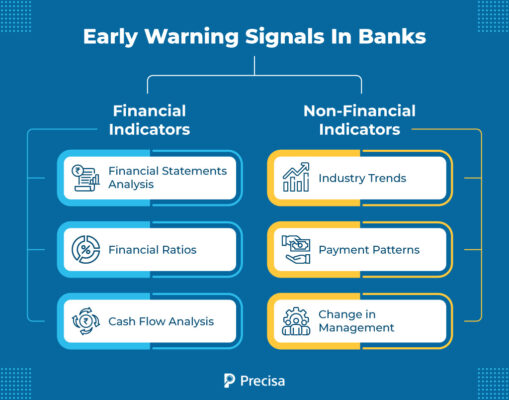
Early warning signals in banks fall into two broad categories: Financial and Non-Financial Indicators.
Financial Indicators
Recognising liquidity issues in a business early is crucial for banks to manage their risk exposure and protect their financial stability. Below are a few ways banks can achieve this:
1. Financial Statements Analysis
Reviewing financial statements offers valuable information regarding trends and can point to anomalies that could indicate liquidity issues for a business. The financial statements play a crucial role in determining liquidity by clearly pointing out the amount of cash and bank balances.
Statements such as the Income Statement, Balance Sheet, Cash Flow Statement, Statement of Changes in Equity and Notes to Accounts collectively offer information about the ability of a business to repay or service a loan in a timely fashion.
AI-driven financial statement analysis tools can help lenders assess liquidity risk early and prevent defaults. Balance Sheet Analysis helps lenders make informed credit decisions.
2. Financial Ratios
Financial ratios can also help banks estimate a firm’s ability to meet its short-term and long-term obligations and overall financial health.
Lenders can use the current ratio and the quick ratio to get a better picture of the short-term liquidity situation.
- The current ratio compares a company’s assets to its liabilities. A higher ratio suggests the business has a more substantial asset base to cover its short-term obligations.
- The quick ratio, on the other hand, offers a more stringent liquidity assessment and excludes inventory from the calculation as it cannot be quickly convertible to cash. A quick ratio above 1 is a strong sign that the company can comfortably handle its short-term liabilities without relying on selling inventory.
- The debt-to-equity ratio and the interest coverage ratio help in assessing long-term liquidity. It measures the proportion of capital financed by debt compared to equity. A lower ratio points to greater long-term financial flexibility as there is less reliance on debt.
- The interest coverage ratio compares the earnings before interest and taxes (EBIT) to the interest expense. A higher ratio means the business has enough earnings to cover its interest payments and can manage long-term debt obligations.
3. Cash Flow Analysis
Cash flow analysis examines a company’s cash inflows and outflows over a specific accounting period. The three integral aspects of cash flow statements that help make a comprehensive analysis comprise cash from operations, financing, and investing.
A favourable cash flow signifies positive fiscal health and improves the company’s creditworthiness. Understanding the timing and predictability of a business’s cash inflows and outflows helps identify potential cash flow shortages and liquidity risks.
AI-powered bank statement analysis tools help extract account receivable and payable reconciliation and also simplify the job of collecting and evaluating bank statements for better cash flow analysis.
Non-Financial Indicators
While financial indicators are integral for assessing the liquidity of a business, non-financial indicators also act as early warning signals in banks.
1. Industry Trends
A business does not operate in a vacuum, and monitoring industry trends is essential to assess the liquidity profile of a business. Assessing these trends can identify potential challenges specific to the industry and how they may impact the business performance.
2. Payment Patterns
Observing the customer payment pattern also offers useful insights into the liquidity of a business and acts as an early warning signal in banks. An increase in late payments or defaults indicates impending financial difficulties for the business.
For example, Days Past Due acts as an early warning system for financial institutions and lenders. Calculating DPD can help banks spot the onset of delinquency well before it escalates into a more severe issue.
3. Change in Management
A business’s success is closely linked to its management; hence, leadership changes are among crucial early warning signals in banks. Frequent changes in top management or the exit of some key personnel are indicators of instability and can influence the business’s liquidity and financial health.
To Sum It Up
A combination of early warning signals in banks offers a comprehensive view of the liquidity profile of a business and helps lenders act proactively to safeguard their interests.
Precisa offers a valuable tool to help banks and lenders identify early warning signs. The Bank Statement Analyser is an analytics tool that extracts data from the bank statement, classifies and categorises transactions, analyses the data, and detects fraudulent transactions and other anomalies.
Book a free trial to learn more.


