
Real-Time Bank Account Verification for Lenders: How It Works
Loan evaluation in India still depends heavily on bank account verification, but the number of applications banks, NBFCs, DSAs, and advisory firms handle every day is much higher and complicated than what traditional processes were built for. Many credit underwriters still rely on manual checks, even though the Reserve Bank of India’s 2022 Digital Lending Guidelines highlighted concerns around digital scams, identity misuse, and sophisticated documentation manipulation. These risks become disproportionately severe when loan officers assess multiple bank accounts, PDFs, scanned files, and screenshots without any uniform structure.
Manual bank statement verification processes take weeks, straining operations while customers wait anxiously. It creates a bottleneck that costs time, resources, and money. The advent of digital lending has made the gap even more prominent. Bank statement analysis driven by automation eliminates these issues in real time. It reduces processing time from days to hours, while improving accuracy and aiding compliance teams, auditors, and DSAs by flagging irregularities early.
This blog post explains how real-time bank account verification works, and how Precisa’s cloud-based, AI-powered bank transactions and financial data analytics can support your lending team with accurate risk checks and structured reporting at scale.
Key Takeaways
- Real-time bank account verification uses automation to extract, validate, and analyse bank statement data within minutes, instead of the days or weeks manual review takes.
- It works in five steps: document processing and fraud detection, transaction classification, cross-verification of declared income, credit assessment, and workflow integration.
- Precisa supports 1200+ bank formats across 850+ banks in 25+ countries, and detects tampering through metadata, font consistency, and balance recalculation checks.
- It doesn’t replace underwriters’ judgement. It removes the manual data-extraction bottleneck so underwriters spend more time on the actual credit decision.
Why Manual Verification is No Longer Enough in the Indian Lending System?
Loan officers are already trained to identify common red flags in bank accounts, but manual verification limits how much information underwriters can process within set timelines. Most lenders need to handle multiple statement formats, irregular statement quality, and different levels of data clarity. These make standardised analysis difficult.
Teams also spend considerable time reconciling balances, identifying EMIs, checking salary patterns, and verifying income stability. When loan volume increases, these manual steps stretch the process further. Underwriters then start prioritising only visible entries and miss deeper behaviour patterns. Despite experience, manual evaluation always carries the risk of oversight.
Compliance guidelines compound these issues even more. Regulatory bodies now need lenders to have faster turnaround times, internal audit readiness, and transparent assessment trails. Lenders cannot afford lengthy processing without compromising accuracy. Forged PDFs and PDF-to-image scams have become even more sophisticated, making manual detection nearly impossible.
Precisa’s real-time verification has set the standard for these bottlenecks by providing immediate, legitimate, and accurate insights into borrowers’ financial health, creating a more robust and reliable foundation for lending decisions.
What is Real-Time Bank Account Verification?
Real-time bank account verification refers to automated systems that analyse, interpret, and validate all types of financial data from uploaded bank statements within minutes. Precisa’s AI-powered platform identifies transaction types, repayment patterns, and irregular entries across 1200+ bank formats from 850+ banks using OCR (Optical Character Recognition) and machine learning algorithms. They also detect anomalies and calculate risk scores with rule-based checks and AI-driven pattern recognition.
Unlike traditional verification, where officers review statements page by page, automated systems scan entire statements simultaneously without human intervention. They detect tampered documents by analysing metadata, font consistency, and calculation accuracy.
Integration with existing lending workflows further enables underwriters to receive uniform categories, clean summaries, and ready-to-use reports.
For lending teams, the benefits are substantial. Lenders gain access to tamper-proof insights immediately, DSAs increase sales and reduce resubmissions, and CAs and advisers get consolidated visibility across multiple accounts.
How Precisa’s Real-Time Bank Account Verification Works
Precisa converts raw bank transactions into underwriting-ready intelligence through five integrated steps:
Document Processing and Fraud Detection
Lending teams upload bank statements on a highly secure analytics platform. The platform accepts statements from multiple bank accounts simultaneously, supporting various formats, including PDF, scanned copies, or images, and different regions, like European or African institutions. OCR technology extracts transaction details, including dates, amounts, cheque numbers, interest entries, monthly patterns, descriptions, and balance information. The system then validates digital signatures, examines font consistency across pages, and recalculates closing balances to detect manual edits.
Tampering detection catches common manipulation tactics like modified PDFs, edited rows, hidden layers, value mismatches, fabricated salary credits, and altered closing balances. These checks are completed during initial processing, flagging suspicious documents before analysts engage.
Transaction Classification, Pattern Analysis, & Risk Flagging
Machine learning algorithms categorise transactions into more than a hundred predefined groups. Salary credits, other sources of income, EMI debits, GST payments, recurring subscriptions, and utility payments receive their own appropriate sections and tags. This classification helps in FOIR evaluation and risk assessment.
The system captures all fixed obligations, not just formal EMIs but also recurring payments to private lenders that appear as individual transfers.
Behavioural analysis algorithms help examine circular transactions, unusual cash movements, and unexplained inflows. The system also highlights income stability, average monthly balance trends, and repayment discipline.
Precisa can flag over 20 irregularity types: round-number deposits, holiday deposits, dormant accounts suddenly active, and balance volatility exceeding sector norms. Each flag includes supporting transaction details for analyst review.
Cross Verification and Income Validation
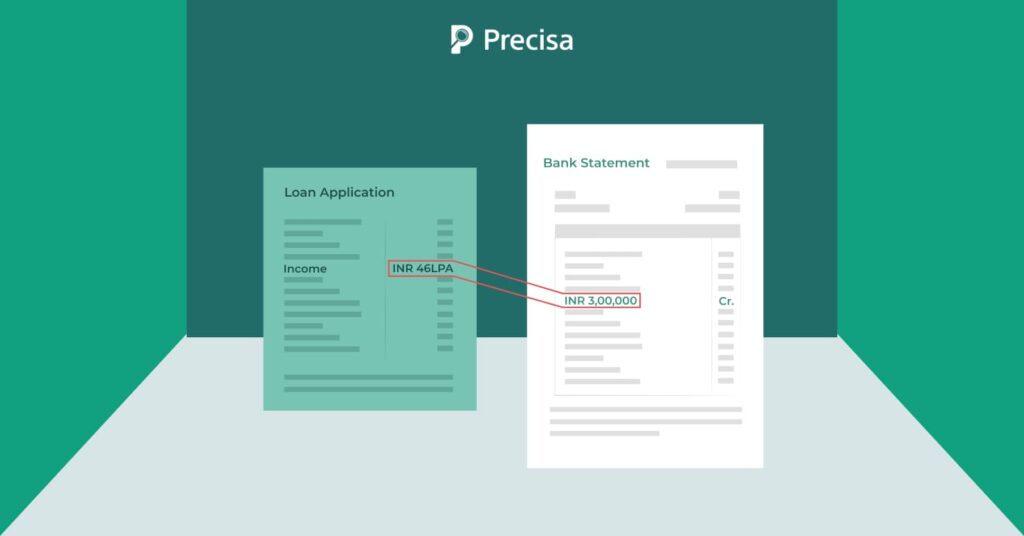
Declared income on applications is compared against actual deposits. Any discrepancy triggers instant alerts. The system also identifies income sources, such as single employer versus multiple clients, and validates consistency across months.
For business accounts, it analyses cash flow patterns against the turnover stated in the loan application.
Meanwhile, interbank transfer analysis stops income from being overstated. When borrowers submit statements from multiple banks, Precisa tracks fund movements between accounts. Money transferred from Account A to Account B is counted once, ensuring income isn’t duplicated.
Credit Assessment
Based on the analysed data, the platform calculates creditworthiness indicators. Monthly average balance, cash flow stability, and existing loan obligations inform the assessment. The platform compares declared income against actual bank deposits. This provides lenders with a clearer view of credit behaviour.
Integration and Workflow Automation
API integration embeds real-time verification into existing loan origination and management systems. Underwriters receive structured reports instead of raw statements. Export options allow teams to share only what they need – compliance teams get AML flags, credit teams receive scoring summaries, and documentation teams extract transaction histories.
This multi-user architecture supports organisational hierarchies. Branch managers access only regional files, DSAs view only their assigned cases, while central administrators maintain system-wide visibility. Such precise role-based permissions protect data and maintain efficiency across operations.
Features that Make Precisa Highly Accurate for Real-Time Bank Account Verification
Precisa is an AI-powered financial data analyser built with automated document processing and specialised analytical modules to help users address specific verification challenges. Listed below are the real-time capabilities of this highly intuitive platform:
- Supports real-time bank statement analysis from 25+ countries, processing 1200+ statement formats across 850+ banks. The capability matters for lenders processing NRI applications or businesses with international transactions.
- Supports multiple languages, including French and Portuguese. Handles multiple currencies but provides unified analysis for both foreign and domestic transactions.
- Counterparty analysis reveals dependency risks, tracks relationship stability, and helps auditors detect related-party links, unusual patterns, and possible fund diversion.
- The AML module applies FIFO (First-in-First-Out) logic to trace funds, flagging accounts with unprecedented balance fluctuations within days.
- Transaction volume analysis compares recent activities against historical averages to detect suddenly mobilised dormant accounts.
- Mode-of-transaction analysis detects structuring attempts, such as multiple cash deposits below reporting thresholds, frequent same-day credit-debits, and unusual RTGS patterns.
- Consolidated analysis reveals complete financial behaviour, including aggregated EMI, total income across accounts, and net cash flow position.
- Interbank transfer tracking to prevent double-counting.
- Generates three score metrics: Precisa Score for repayment probability, Volatility Score for cash flow stability, and FOIR calculation that captures total fixed obligations as a percentage of verified income (acceptable threshold: below 55%).
- Can be used as a stand-alone web app or integrated with loan origination and loan management systems or credit bureau analysers using APIs.
Frequently Asked Questions
1. What is real-time bank account verification?
It’s an automated process that reads, validates, and analyses bank statement data as it’s uploaded, flagging tampering, income inconsistencies, and repayment risk within minutes rather than days.
2. How does real-time verification detect tampered bank statements?
It checks digital signatures, font consistency across pages, and recalculates running balances. A tampered entry usually breaks the balance chain, which the system flags automatically.
3. Does real-time verification replace manual underwriting?
No. It removes the manual data-extraction and categorisation work, so underwriters spend their time on risk interpretation and the lending decision rather than reading statements line by line.
4. Can real-time verification handle multiple bank accounts at once?
Yes. It processes statements from multiple accounts simultaneously and tracks interbank transfers, so funds moved between a borrower’s own accounts aren’t counted twice as income.
5. What formats and banks does Precisa’s verification support?
Precisa supports 1200+ bank statement formats across 850+ banks in 25+ countries, including PDF, scanned copies, and images.
Conclusion
Real-time bank account verification doesn’t replace underwriters’ expertise or judgment, but instead, enhances their efficiency and accuracy by removing manual processing bottlenecks. This way, lenders spend less time on data extraction and categorisation, and more time on risk interpretation.
Precisa’s web-based, AI-driven analytical solution with intuitive automation is at the forefront of this innovation. It allows decision makers in the field of lending, insurance, and wealth management to upload documents and fetch data in real-time from the source.
The technology addresses specific pain points, including inconsistent format handling, tampering detection, FOIR accuracy, and interbank transfer tracking. From NBFCs scaling lending applications to forensic auditors investigating complex cases, Precisa provides both speed and analytical depth in under 60 seconds.
Experience Precisa’s real-time verification capabilities firsthand. Upload any bank statement and try Precisa for free. You can also register for a free trial.


