How GSTR Integration Improves Loan Origination Systems
India’s demand for credit is vast, yet a significant portion of the population lacks formal credit access.
For example, in the MSME sector, only 14% of businesses have access to formal credit mechanisms.
The challenges in assessing borrowers’ creditworthiness are one of the main reasons for this. This stems from a lack of transparency and the unavailability of quality financial data.
As of June 2023, there are around 1.4 crore registered businesses due to the widespread adoption of GST in India. Leveraging this GSTR integration in the loan origination system can be an effective solution to streamline the credit evaluation process.
This article explores how integrating GSTR data can transform loan origination and lending.
What is GSTR?
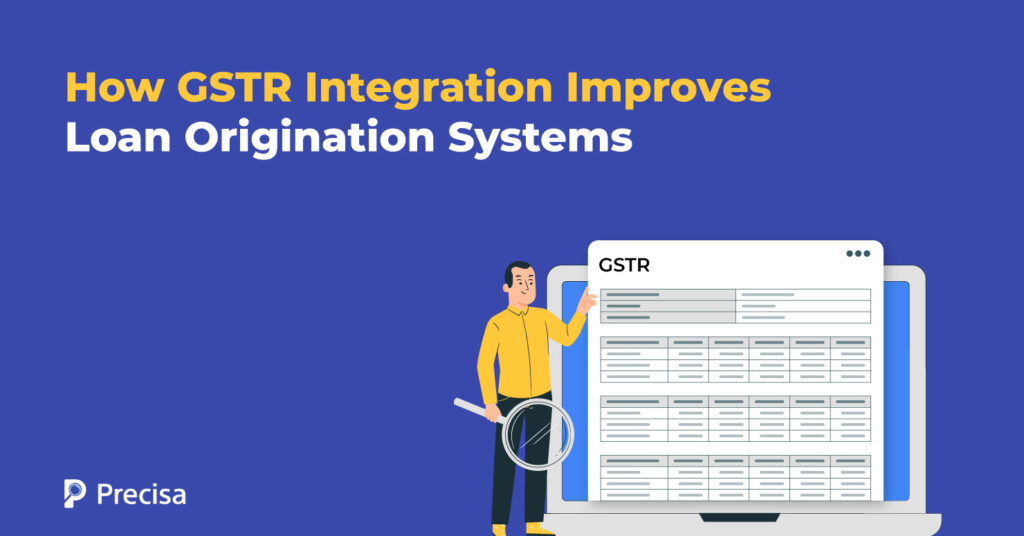
Since the introduction of the GST regime in 2017, businesses have had to file GST returns at regular intervals. It provides data related to sales, purchases, taxes filed, and other financial details that lenders can leverage to understand the financial standing of borrowers.
GSTR analysis tool processes GST return data to examine patterns, inconsistencies, and trends, offering crucial insights into a business’s operations.
These tools often include features like:
- Automated GST returns filing
- Error detection and correction
- Reporting and analytics capabilities
- Reconciliation of data
This tool helps organisations analyse the information submitted in their regular GST returns, providing valuable data for financial decision-making and compliance monitoring.
Besides that, GSTR analysis tools can:
- Generate detailed GST compliance reports
- Provide real-time insights into GST filings
- Assess the creditworthiness of companies
- Offer a better understanding of business cycles
- Identify potential risks
- Benchmark performance of businesses
Traditional Loan Origination Systems: An Outline
The limitations of traditional loan origination systems have highlighted the need for GSTR integration to enhance efficiency and accuracy in the lending process. Some of the key challenges that have driven the adoption of GSTR analysis include:
- Manual time-consuming verification: Evaluation of financial statements was slow and often prone to error.
- Inconsistency in data: Small and marginal firms often struggle to maintain regular and coherent data, making it complex to measure creditworthiness.
- Outdated financial data: The absence of real-time data based on current performance limited the ability of lenders to make informed credit choices.
How GSTR Integration Transforms Loan Origination Systems

There are multiple advantages of GSTR integration in the loan origination system:
Faster Loan Approval
With the integration, data such as monthly revenues, sales and purchase invoices, tax filing status, business activity verification, company details, etc., can be automatically retrieved from the government portal, unlike traditional manual collection and verification.
For instance, for the application for business loans, there is no need to submit physical copies of sales data, tax payments, etc.
This not only accelerates the lending service but also minimises the chance of human errors and reduces operational costs.
Better Risk Assessment and Fraud Detection
Real-time tracking of GST fillings provides a much more precise scenario of the financial standing of the businesses. The pattern analysis of GST data allows for the identification of potential risks, promptly acting as an early warning system for lenders.
For example, a mismatch in GSTR-1 (sales) and GSTR-3B (summary) could indicate inflated purchases and underreporting of sales.
Since the data is from verified government sources, it adds an extra layer of security, mitigating data manipulation risks. This safeguards lenders against fraud while ensuring that creditworthy businesses receive fair access to loans.
Informed Decision Making
By accessing real-time GSTN data and using advanced analytics, lenders can now predict revenue trends, assess seasonal cash flows, and make more informed lending decisions.
Personalised Loan Products
A country as diverse as India cannot have a one-size-fits-all approach to loan systems. The GSTR analysis allows lenders to understand sector-specific insights and will enable them to create tailored offerings. This further improves customer satisfaction.
For example, for an e-commerce business, lenders can offer a lower-interest loan, which has shown consistent sales growth and GST payments.
Key Considerations for GSTR Integration in Lending
While GSTR integration offers significant advantages for loan origination, lenders need to be mindful of some potential challenges:
1. Data Quality and Integrity
Ensuring the data is accurate, complete, and consistent is necessary for the efficacy of GSTR analysis. The inaccurate data may lead to flawed credit assessment and increased risks of default.
For example, in 2017-18 and 2018-19, tax officials sent GST notices to around 33,000 businesses for discrepancies and shortfalls in payments.
2. Technology Adoption and Consumer Awareness
Adoption requires both operational shifts and technological upgrades, which may raise the initial investment cost for capacity building.
Further, the awareness of regular and accurate GST filing for easy loan approval would be needed to accelerate its adoption.
3. Compliance and Security Measures
Lenders have to keep their systems in alignment with the updated GST and RBI’s data privacy regulations. As the GSTR system deals with sensitive financial information, it would also need robust security systems to address cyber vulnerabilities.
4. Balance of Automation and Human Judgement
While the automated GSTR analysis provides a holistic and objective evaluation, human judgement would remain significant in complex loan applications that do not fit standardised patterns.
For instance, the automated system may unfairly reduce the credit rating of seasonal businesses like textile and agricultural due to turnover fluctuations despite their strong fundamentals.
The Takeaway
The GSTR integration in loan origination systems has transformed the way lending industries used to work. It provides an in-depth analysis of GST data, including red flags, enabling sophisticated risk assessment.
It also empowers lenders to navigate the complexities of the Indian market with increasing confidence and efficiency.
Precisa’s GSTR Analysis tool will provide you with real-time analysis and assign a creditworthiness score—the Precisa Score. Beyond this, you can also use other services, such as Account Aggregator and Bank Statement Analysis, to make strategic decisions.
Sign up to try it yourself now!