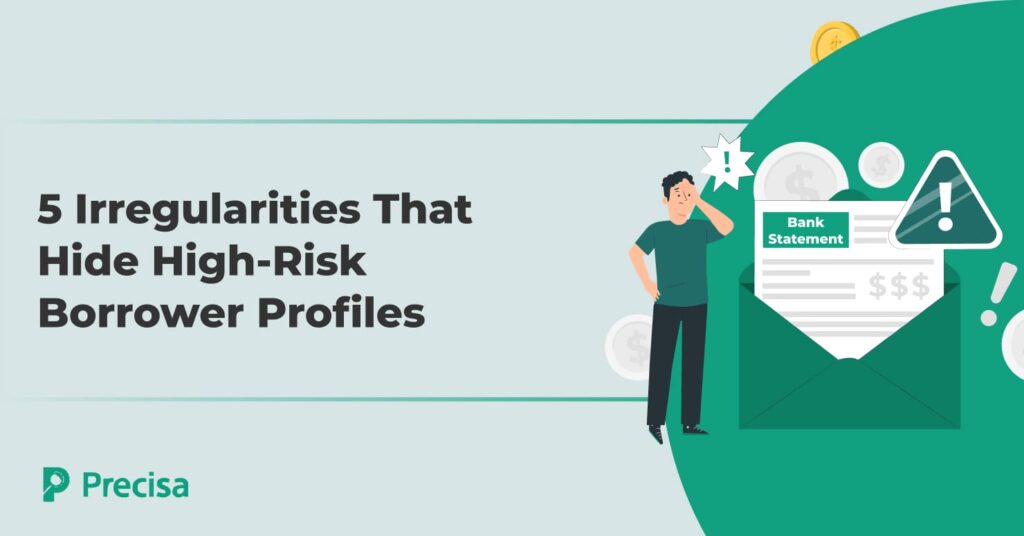
5 Bank Statement Irregularities That Hide High-Risk Borrower Profiles
Your partner bank rejects another application. Third one this month. The reason? “Applicant creditworthiness concerns.” But the salary looked solid, the CIBIL score was decent, and the statements seemed clean.
But here’s what happened: somewhere in those 60 pages of bank statements, an irregularity signalled high risk. Your manual review missed it. The bank’s automated system caught it. Now your rejection rate climbs, and your DSA rating takes another hit.
The gap between top-rated DSAs and those struggling with rejections often comes down to one thing — catching bank statement irregularities that look harmless in isolation but reveal serious problems when connected. Your team processes 20-30 applications weekly. Now, manual review can’t track patterns across multiple statement pages whilst maintaining speed.
The cost shows up later: applications that look clean during manual review get rejected by bank systems for patterns your team couldn’t spot across 60+ pages of statements. These aren’t exotic fraud schemes. They’re common bank statement irregularities that hide in plain sight when reviews are rushed.
Here are five bank statement irregularities that frequently hide high-risk borrower profiles in applications that look legitimate at first glance.
1. Salary Credits That Disappear Within 48 Hours
The applicant shows ₹75,000 monthly salary credits. Regular deposits confirm strong income. Your team marks it verified and moves forward.
But look closer at the debits. The same ₹75,000 exists within 24-48 hours of each salary credit. Pattern repeats for six months straight. This isn’t income. Someone’s cycling money through the account to inflate credentials.
Actual disposable income? Near zero. Repayment capacity doesn’t exist.
Per RBI guidelines, lenders must verify the sustainability of income, not just the presence of credits. When the same amount enters and exits repeatedly, cash flow analysis reveals the truth. Your team verifies regular salary credits and approves the application. Connecting those credits to immediate, recurring debits across multiple pages requires pattern tracking, but most teams don’t have time for it when juggling dozens of files.
2. Balance Calculations That Don’t Add Up
A statement shows an opening balance of ₹1,25,000. After transactions, the closing balance shows ₹1,45,000. Looks consistent. You move to the next verification step.
Do the maths yourself. Calculate the closing balance using the opening balance + credits – debits. The number doesn’t match the stated closing balance. The difference could be ₹20,000 or more.
This signals statement tampering.
Fraudsters edit PDFs to inflate balances or hide large debits, banking on reviewers not recalculating every balance across 60+ transaction pages. If the computed balance differs from the stated balance by even ₹5,000, something was altered.
Recalculating opening and closing balances for every page in a 12-month statement isn’t realistic when you’re processing applications manually. Tampered statements rarely show obvious formatting errors anymore, which is why automated fraud detection catches what human eyes miss during rushed reviews.
3. Cash Deposits on Days Banks Stay Closed
Take this example: ₹40,000 cash deposit on 15th August (Independence Day). Another ₹35,000 on 2nd October (Gandhi Jayanti). Applicant claims business income, so multiple cash deposits throughout the year seem normal.
Except banks don’t process cash deposits on national holidays.
These entries were manually added to the PDF after the fact. This irregularity is binary, either the bank was closed (entry is fake) or it wasn’t. No legitimate explanation exists.
Your reviewers focus on deposit amounts and frequency, not transaction dates against holiday calendars. Matching every transaction date to bank holiday schedules across multiple months isn’t standard practice in manual workflows. But partner banks check this. When their systems flag it, and you didn’t, your credibility drops.
4. Money That Never Stays in the Account

₹5 lakh credited on 3rd June. ₹4.8 lakh debited on 5th June. ₹6 lakh credited on 18th June. ₹5.9 lakh debited on 20th June. The pattern continues month after month.
The account exists to move money, not hold it. High-value credits followed by near-identical debits within days signal money laundering or benami arrangements.
The applicant controls the account on paper but isn’t the economic beneficiary. Repayment capacity is fictional.
Individual transactions look normal: ₹5 lakh credit suggests strong cash flow. Manual review doesn’t track what percentage of credits gets withdrawn and when. When 80-90% of credited amounts exit within 72 hours consistently, you’re looking at FIFO (First In, First Out) patterns that RBI’s Financial Intelligence Unit specifically tracks as money laundering red flags.
Counterparty detection and transaction analysis require computational capabilities that manual review can’t match. Your team moves from page to page, transaction to transaction. Pattern recognition across months of data needs different tools.
5. The EMI Obligations Credit Bureaus Don’t Show
The credit bureau shows two loans: a home loan EMI of ₹18,000 and a car loan EMI of ₹12,000. FOIR calculates to 35% against an ₹85,000 monthly income. Well within acceptable limits. You submit the application.
Bank statement reveals ₹25,000 cash withdrawal on the 5th of every month for eight months straight. Same date, same amount. This isn’t captured in CIBIL because it’s informal lending—local financier, peer-to-peer loan, business debt not reported to credit bureaus.
Actual FOIR isn’t 35%. It’s closer to 65%. The applicant is already stretched thin. Default risk is high, but your manual review treated statement analysis and bureau checks as separate verification steps. Matching recurring cash withdrawals or NEFT transfers to EMI patterns requires cross-referencing workflows that most DSAs don’t have standardised.
Why These Patterns Slip Through (And Why It Matters Now)
Each irregularity alone raises concern. Combined, they create applications that look clean on the surface but hide serious risk underneath.
Your team reviews 20-30 applications weekly. Manual workflows separate statement analysis from credit bureau checks from income verification. Patterns that span multiple documents or months of transactions stay invisible until after submission.
Consider this: the applicant shows a ₹90,000 monthly salary (inflated via circular transactions). Statement has a ₹15,000 balance mismatch (tampering). ₹30,000 cash deposit falls on Republic Day (forged entry). FIFO patterns show 85% of deposits exit within 48 hours. Recurring ₹20,000 cash withdrawals suggest hidden EMI obligations.
Approval rate in manual review? High, because each red flag lives on different pages or documents. Default rate after six months? Predictably high.
Recent RBI data shows bank frauds hit ₹36,014 crore in FY25, with 92% linked to loans where high-risk borrower profiles hid behind exactly these kinds of bank statement irregularities. Public sector banks bore 71% of losses. Detection improved, but processing delays and weak underwriting during rapid lending growth let patterns through.
For DSAs, this means partner banks are tightening scrutiny. Unauthorised lenders topped the 2024 risk survey, and RBI’s Early Warning System mandates are forcing banks to scrutinise every application harder. The applications that slip through your review but get flagged by bank systems? Those hurt your rating directly.
How Top DSAs Stay Ahead
The DSAs thriving now aren’t processing the most applications—they’re submitting the cleanest ones. Rejection rates of 5% vs 15% often come down to catching these five bank statement irregularities before submission.
You can’t manually track circular transactions across 80 pages whilst juggling 25 applications. You can’t recalculate every balance or match transaction dates to holiday calendars without dedicated tools.
This is where automated bank statement analysis changes the game. Precisa has processed over 1.5 million bank statements across 1000+ clients in 25+ countries, analysing more than 51 crore transactions. Supporting 850+ banks and 1200+ statement formats means we’ve seen every variation of these five bank statement irregularities.
Precisa’s Bank Statement Analyser processes statements in 30 seconds, automatically flagging:
- Circular transactions: Maps credits to debits with exact matching patterns across the entire statement period, showing when the same amount enters and exits within 24-72 hour windows.
- Balance mismatches: Recalculates every opening and closing balance, comparing computed balances against stated balances. When there’s a mismatch, you see the exact amount and location instantly.
- Cash deposits on bank holidays: Maintains comprehensive holiday calendars for every region, flagging any cash deposit on days banks stay closed.
- FIFO patterns: Calculates exactly what percentage of deposits exit within 24, 48, and 72 hours, mapping inter-bank transfers and identifying counterparties automatically through AML analysis.
- Hidden EMI obligations: Detects recurring cash withdrawals and NEFT transfers, identifying informal lending obligations that credit bureaus don’t capture.
When you submit clean applications with verified income and identified risks disclosed upfront, banks trust your pipeline. Your credibility grows. Your business scales.
Ready to Catch What Manual Review Misses?
Try Precisa free. Upload one statement. See what you’ve been missing.