
Skip to content
Email: contactus@precisa.in
Phone number: +91 98450 76647
  • Products
    • Bank Statement Analysis
    • GSTR Analysis
    • Credit Report Analysis
    • Anti-Money Laundering (AML) Analysis
    • Account Aggregator Integration
    • DSA Service
    • Forensic Investigation
    • API Integration
  • Industries
    • NBFC
    • DSA
    • Govt. Departments
    • CA Firms
    • Forensic
    • Fintech
    • Enterprise
    • Advisory
    • International
    • TSP
    • Private Lender
  • Solutions
    • Use Cases
      • For CA and Tax Professionals
      • NRI Bank Statement Analysis
      • NBFCs & Fintech Companies
      • For Private Lenders
      • For Insurance Underwriting
      • Credit Bureau Report Analysis
      • GSTR Analysis Tool
      • ITR Analysis Tool
      • Fraud Detection
    • Supported Banks
      • All Supported Banks
      • Indian Banks
      • US Banks
      • Middle East Banks
      • Malaysian Banks
      • International Banks
      • European Banks
      • Canadian Banks
      • African Banks
      • Payment Banks
    • Blog
  • Clients
  • Pricing
  • Tools
    • ITR Analyser
    • GST Return Analyser
    • Credit Bureau Analyser
    • Bank Statement Analyser
  • Sign In
Try Now
Digital Lending

Digital Banking Rules Encourage Creativity and Ethical Funding
December 23, 2022 Precisa Team No comments yet
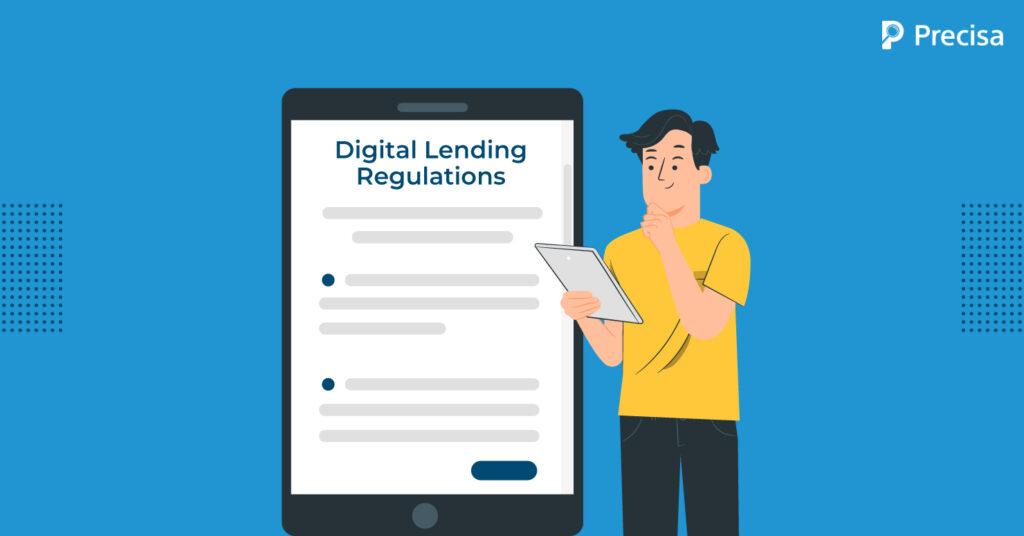
Digital-Lending-Regulations-Advocate-Blend

The traditional banking sector in India has always been highly regulated. While this approach has created a haven for millions of consumers to meet their financial needs, it has also served as a barrier, keeping many outside the purview of the banking system.

However, digital lending has emerged as a disruptor at scale.

As of November 2022, the estimated value of India’s digital lending market share is $ 200 billion. It is expected to rise to $ 350 billion by 2023. Non-banking financial companies (NBFCs), fintech, and banks are leveraging fintech solutions as a key vehicle to disburse loans rapidly. In September 2022, the Reserve Bank of India (RBI) rolled out new guidelines for commercial banks, NBFCs, and cooperative banks engaged in digital lending.

In this blog, let’s understand the state of digital lending, the key drivers behind the RBI guidelines, and its future.

Current State of the Digital Lending Landscape 

India’s credit landscape has drastically evolved over the last few decades. From a point where it was challenging to secure a loan due to stringent eligibility criteria, it has become significantly easy to secure via digital lending channels. Consumers can secure a loan of a relatively smaller ticket size, even without a credit score.

Types of loans can range from personal, educational, and business loans. Some fintech businesses have created a unique business model by offering to facilitate purchases of products such as electronics or through cash disbursements.

Another trend that has become relatively popular is Buy Now Pay Later (BNPL). This scheme enables consumers to access products without a credit or debit card by paying 25% or less of a product’s value upfront and the rest in instalments.

A Few Negative Fallouts

Access to credit via digital lending has been a game changer for many underserved segments, including the MSME sector, women, and remote consumers. However, it is also had some adverse impacts:

  • Risk of Low Profitability

Even the highly regulated banking sector has witnessed a significant growth of non-performing assets, from INR 1.8 trillion in the financial year 2019 to INR 2 trillion in the financial year 2021. An unregulated digital lending landscape is also witnessing a similar trend, which impacts the profitability and sustainability of digital lenders.

  • Debt trap and Lack of Financial Literacy

It has given rise to a scenario where consumers have easy access to loans and schemes to BNPL without having the means to make payments. Consequently, it is plunging them into ever-piling debt. Many consumers also need more financial literacy and need to be made aware of interest rates, payment schedules, and other metrics.

  • Fraud

While many digital lenders are genuine businesses, an unregulated landscape has given rise to fraudulent players such as fake lending apps.

A Snapshot of RBI Digital Lending Guidelines 

There are three core entities involved in the digital lending process – regulated entities (REs), digital lending applications (DLAs), and lending service providers (LSPs) partners.

The digital lending guidelines span the full spectrum of lending processes:

  • Loan disbursals and repayments are to be executed only between the borrower’s bank account and the RE, which comprises banks and NBFCs.
  • In the credit intermediation process, any fees payable to LSPs must be paid directly by regulated entities (REs) and not by the borrower.
  • The borrowers are to be provided with a standardised key fact statement (KFS) before the execution of a loan. The KFS must include the annual percentage rate (APR) or interest, which is an all-inclusive cost.
  • The loan contract must include a cooling-off period, allowing borrowers to exit digital loans by paying the principal amount, and a proportionate APR sans a penalty.
  • Digital lenders must take a borrower’s consent before executing for credit limit increase.
  • REs must appoint a nodal grievance redressal officer to address fintech/ digital lending-related complaints.
  • If an RE does not resolve a borrower’s complaint within 30 days of registering it, the borrower can complain with the RBI’s Integrated Ombudsman Scheme.

Key Takeaway 

The new RBI guidelines protect consumer rights and the very survival of all stakeholders in the digital lending sector. A culture of innovation and responsible digital lending practices must thrive side-by-side for digital lending to be an inclusive, sustainable and profitable business.

Today, many digital lending businesses are leveraging innovative tools such as financial statement analysis software to help make informed lending decisions and process applications efficiently and at scale.

Presica’s user-friendly bank statement analyser aims to simplify the analysis process through automation, enabling results to be delivered in minutes. The solution provides actionable insights on an easy-to-use dashboard, helping businesses make informed lending decisions.

Contact us for a free demo today!

  • Digital Lending
  • Fintech

Post navigation

Previous
Next

Leave a Reply Cancel reply

Your email address will not be published. Required fields are marked *

Search

Categories

  • Bank Statement Analysis (201)
  • Credit Appraisal (67)
  • Digital Lending (125)
  • Fintech (84)
  • Fraud & AML Detection (6)
  • NBFC Software (10)
  • Understanding Precisa (27)

Recent posts

  • Live vs Closed Loans
    Live vs Closed Loans: What a Credit Bureau Report Shows
  • Loan Processing Still Relies on Manual Work
    Why NBFC Loan Processing Still Relies on Manual Work
  • Best GST Analysis APIs in India (2026): 7 Options for Lenders Compared
    Best GST Analysis APIs in India (2026): 7 Options for Lenders Compared

Tags

Account Aggreagtor AI in Fintech AML compliance API To Get Bank Transactions Automated Bank Statement Analysis Bank Accounts Bank Financial Statement Analysis Bank Statement Analysis Bank Statement Analysis API Bank Statement Analysis Tools Bank Statement Fraud Detection BNPL Co-Lending credit analysis Credit Appraisal Credit Appraisal Software Tools Credit Assessment Credit Bureau Data Quality and Integrity Digital Lending Due Diligence early warning signals Embedded Finance Financial Data Analysis Tools Financial Inclusion Financial Industry Financial Security Financial Statement Analysis Software Fintech Fintech Companies fraud detection Fraud Investigation GST analysis API GSTR GSTR Analyser ITR Analysis Lenders Loan Management System Money Laundering MSME NBFC NBFC lending Open Banking Precisa RBI

Continue reading

Mismatches Between GSTR-2B and GSTR-3B - Feature Image
Fintech

How to Reconcile ITC Mismatches Between GSTR-2B and GSTR-3B

September 2, 2026 Soma Sharma No comments yet

Every month, thousands of businesses claim input tax credit in GSTR-3B that does not fully match GSTR-2B. Sometimes it is a vendor who filed late. Sometimes it is an invoice booked in the wrong period. Either way, the GST system now catches the gap on its own, and it does not wait for an audit […]

Tally Have a Cloud Version
Fintech

Does Tally Have a Cloud Version? A Straight Answer for CAs and DSAs

August 14, 2026 Soma Sharma No comments yet

Yes, Tally has a cloud version, though it isn’t the browser-native product most people picture when they search for it. Tally Solutions sells its own hosted offering called TallyPrime Cloud Access, and it sits alongside a much larger market of third-party “Tally on Cloud” providers who host TallyPrime on a rented Windows server instead. If […]

Verify a GSTIN Online
Bank Statement Analysis

How to Verify a GSTIN Online Before Approving a Business Loan

May 15, 2026 Soma Sharma No comments yet

Business loans involve a basic question that sounds straightforward: is this a real, operating business? At Precisa, it’s a question that runs through thousands of loan files we process for lenders and NBFCs across India. GSTIN verification is one of the fastest ways to answer it, and one of the most skipped steps in informal […]

Mumbai

403, Mayuresh Chambers, 4th Floor, Sector 11, CBD Belapur, Navi Mumbai, Maharashtra - 400614

📍Locate us

Pune

Rachana Park, 3rd Floor, Atreya Society,
Off. Senapati Bapat Marg, Wadarvadi, Pune,
Maharashtra - 411016

Bengaluru

WeWork, Cabin No 02126, 2nd Floor, Vaishnavi Signature,
No. 78/9, Outer Ring Road, Bellandur Village, Varthur Hobli,
Bengaluru East, Karnataka - 560103

Links
  • About
  • Cancellation Policy
  • Terms Of Use
  • Privacy Policy
Tools
  • ITR Analyser
  • GST Return Analyser
  • Credit Bureau Analyser
  • Bank Statement Analyser
Subscribe to our newsletter

Sign up for our weekly newsletter to get the latest news, updates & amazing offers delivered directly in your inbox.


    © All Rights Reserved • Precisa | A Product of Finezza Information Technologies Pvt. Ltd • MADE WITH ❤️ & ⚡ IN INDIA.