Duration Gap Analysis and Liquidity Risk Management: Best Practices for Financial Institutions

Managing liquidity risk is paramount for financial institutions in the ever-evolving world of finance, where uncertainties and fluctuations in markets are constantly present.
Liquidity risk is the loss resulting from the inability to meet short-term payment obligations, significantly impacting a financial institution’s stability and solvency. Financial institutions use different risk management techniques, such as duration gap analysis and liquidity risk management, to navigate this hurdle.
These practices offer priceless insight into interest rate sensitivity and ensure sufficient liquidity to withstand turbulent market conditions.
In this article, we will explore the best practices for duration gap analysis and liquidity risk management, giving financial institutions the tools and techniques they need to manage liquidity risk and maintain their financial standing proactively.
What is Duration Gap Analysis?
Duration gap analysis is a financial management technique employed to evaluate the exposure to interest rate risks of a financial institution, such as a bank or an investment firm. Compare the assets’ and liabilities’ duration to understand how variations in interest rates can affect financial institutions’ net interest income (NII).
What Does the Duration Stand For?
Duration refers to a financial instrument’s weighted average maturity of cash flows. It gauges how sensitively the instrument’s price responds to changes in interest rates. How long it will take to obtain or repay the cash flows linked to an asset or liability is indicated by the asset’s or liability’s duration.
The Function of Duration Gap Analysis
Financial institutions can measure their exposure to interest rate risk using duration gap analysis. A positive gap indicates longer asset durations, which with falling interest rates, equals reduced net interest income. In contrast, a negative gap implies longer liability durations, resulting in higher net interest income with decreasing rates.
Institutions can control risk by adjusting the asset-liability composition, implementing hedging techniques, or adopting interest rate swaps.
What is Liquidity Risk Management?
Liquidity risk management is the process of identifying, evaluating, monitoring, and reducing potential risks associated with the liquidity situation of financial institutions. It ensures the institution has enough liquid assets to meet its obligations and funding requirements during normal and stressed market conditions.
In addition to unexpected fluctuations in financing availability, quick withdrawals of deposits, volatility in the financial markets, and mismatches between assets and liabilities are some of the factors contributing to liquidity risk. Liquidity risk can have serious repercussions if not properly managed, including the institution’s failure to fulfil customer withdrawals, a decline in market trust, and even bankruptcy.
Best Practises for Finacial Institutions: Techniques of Duration Gap Analysis and Liquidity Risk Management
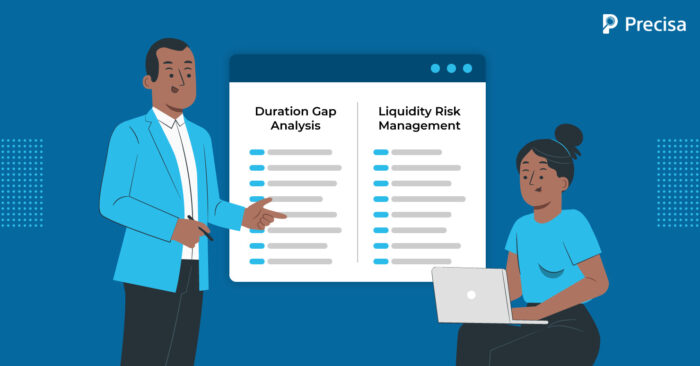
Duration gap analysis and liquidity risk management are crucial for financial institutions to manage their liquidity risk efficiently. In these domains, the following are some best practices for financial institutions:
A. Duration Gap Analysis: best practices
Here are the best practices involved with duration gap analysis:
1. Define And Measure Duration
Duration measures the sensitivity of a financial institution’s assets and liabilities due to fluctuations in interest rates. To correctly determine each asset’s and liability’s exposure to interest rate risk, define and calculate each asset’s duration.
2. Perform Scenario Analysis
Run scenarios to see how fluctuating interest rates affect the institution’s balance sheet. Assess the possible impacts on the institution’s net interest income (NII) and economic value of equity (EVE) of various interest rate scenarios.
3. Identify and Manage Mismatches
Analyse the duration gap, or the difference between the duration of assets and liabilities, to find and manage mismatches. To reduce interest rate risk, find and control any significant mismatches. Consider adjusting the composition of assets and liabilities to minimise the duration gap and decrease risk exposure.
4. Stress Testing
Test in market conditions to see how they impact the institution’s duration gap. This analysis aids in identifying vulnerabilities and creating backup plans to reduce risks.
5. Regular Reporting and Monitoring
The board of directors and senior management should receive periodic reports on the duration gap. This ensures oversight is ongoing and makes it easier to make decisions quickly to manage new risks.
6. Asset and Liability Management Committee (ALCO)
Enhancing liquidity risk management may involve creating an ALCO with senior management representation. ALCOs are essential in managing duration gap analyses, establishing risk ceilings, and creating plans to improve the institution’s balance sheet.
B. Liquidity Risk Management: Best Practices
Now let’s elaborate on the best practices of liquidity risk management:
1. Comprehensive Liquidity Risk Framework
Develop a complete framework for managing liquidity risk that includes guidelines, processes, and constraints to successfully manage liquidity risk. This framework should be in line with the institution’s tolerance for risk and the applicable regulations.
2. Measurement of Liquidity Risk
Implement reliable methods to assess liquidity risks, such as scenario analysis, stress testing, and cash flow predictions. These instruments support identifying essential liquidity buffers and assessing possible liquidity deficits.
3. Diversification of Funding Sources
Avoid overreliance on a single source of funding. To mitigate liquidity risk and assure access to funds under stressful market conditions, diversify the funding sources.
4. Contingency Fund Plan
Create a Contingency Financing Plan (CFP) that details strategies and measures to be implemented in the event of liquidity challenges. Alternative funding sources, prospective asset sales, and access to emergency liquidity facilities should all be included in the CFP.
5. Regular Liquidity Stress Testing
Conduct periodic liquidity stress tests to gauge the institution’s capacity to resist significant liquidity shocks. To assess the appropriate amount of liquidity buffers, test several scenarios, including distinctive and market-wide stress events.
6. Regulator Compliance
Comply with reporting requirements and stay informed on pertinent liquidity risk regulations. This involves keeping a close watch on important ratios, such as the net stable funding ratio (NSFR) and the liquidity coverage ratio (LCR), as required by the regulatory bodies.
Final Note
Financial institutions must do a duration gap analysis to manage their liquidity risk to maintain stability in a tumultuous market. Institutions may proactively manage interest rate risk and reduce liquidity risk exposures using best practices in duration gap analysis.
Effective liquidity risk management includes several critical components: frequent monitoring, stress testing, and thorough contingency planning. These processes allow banks to foresee possible liquidity risks and take proactive measures to mitigate them, maintaining their long-term sustainability and resilience in the face of market volatility.
Precisa is a cloud-based financial analytics platform that enables institutions to measure and manage the risk associated with their loan portfolios.
Our user-friendly Bank Statement Analysis tool simplifies the analysis process by providing actionable insights on an easy-to-use dashboard, reducing processing time by 5x. It enables error-free analysis without human intervention. The analysis helps banks and financial institutions make sound lending decisions.
Sign up for a free demo today!