How Can Banks Speed up and Secure Loan Disbursal?
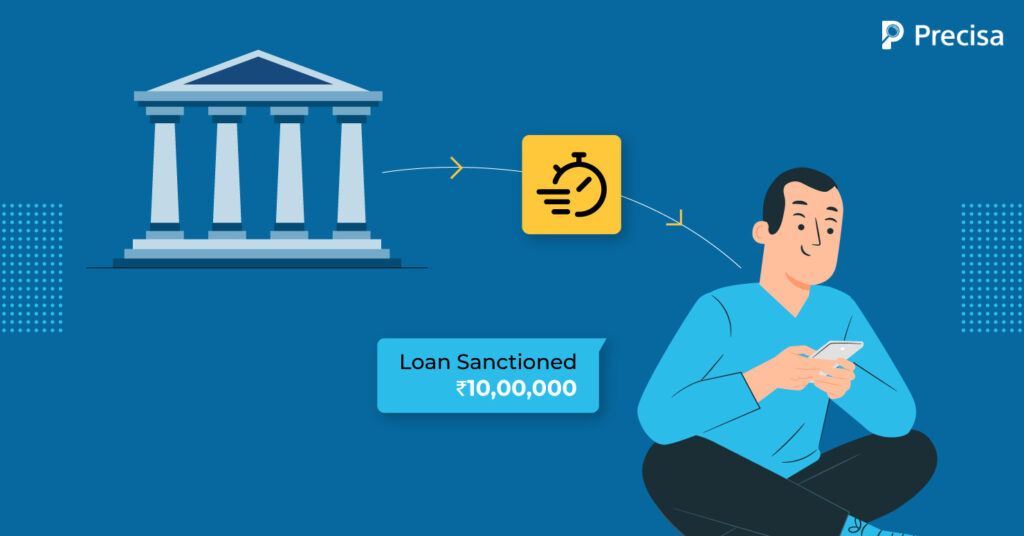
Banks have been speeding up loan approvals and disbursements to consumers to gain a larger share of the burgeoning retail market.
Major banks, including the State Bank of India, ICICI Bank, HDFC Bank, Axis Bank, etc., have slashed their lending turnaround times to as little as one day, and in some cases, as little as 10 seconds.
For instance, HDFC Bank, the country’s second-largest private lender, unveiled a 10-second, nearly real-time loan approval and payout a few months ago, providing digital retail lending with a boost. Moreover, customers only had to click/tap on their Net banking account.
The financial sector is rapidly turning to digital solutions to meet the shifting demands of an increasingly digitally-sophisticated customer base and improve efficiencies and experiences.
Customers’ interactions with banks have already been revolutionised by the internet and mobile technology, and the introduction of digital experiences makes the borrowing process faster and more convenient.
Digitising the Lending Process Can Help Accelerate Secure Loan Disbursements
Unlike other financial products that offer a digital-first experience, most loan approvals still involve manual documentation. Filling out, copying, and delivering physical forms add to the process’s labour costs and delays.
A digital clearance process will bypass the extra effort, the inherent delay of physical forms, and the possibility of a further delay if physical paperwork delivery is disrupted or lost. Digital applications are also more accurate and eliminate the possibility of human error.
Digital lending makes it easier for both traditional and Fintech lenders to monitor operations and evaluate best practices compared to a manual method.
The Move to Digital Lending: Revolutionizing Lending Using Technology

The pandemic wreaked havoc on the global economy, not least the lending business, which saw an increase in digital lending from acquisition through loan administration throughout 2020.
Fintech lenders can now employ automation to increase their underwriting decisions’ speed and accuracy, thanks to the digital shift.
These lenders apply advanced algorithms and analytical tools to traditional and alternative data sources, allowing them to make quick, accurate, and secure lending decisions.
Lenders can automate data collection through the digital process, allowing for speedier analysis of patterns (customers’ financial history), areas for improvement, and potential solutions. In addition, having linked data can help reduce the time it takes to process applications and make decisions.
According to a PYMNTS poll, more than 63% of microbusinesses and 71% of customers would be more loyal to a lender that offers free immediate payments.
Automating the Underwriting Process: How is it Key to a Lender’s Success?
The rise of automation has ushered in a new era of possibilities for using Fintech enterprises for businesses. For example, Fintech organisations can use technologies like Robotic Process Automation (RPA) and machine learning (ML) to capture client information and generate proposed conditions that the client must follow to gain loan approval.
Today’s market has a plethora of technological instruments that are altering the loan industry worldwide. AI, ML, natural language processing (NLP), robotic process automation, and optical character recognition (OCRs) are just a few of the new-age technology developments that have the potential to change the way loan approvals and disbursements are handled.
1. Automation during loan application screening
When tracking and monitoring defaulted loans, AI models track and monitor all incoming payments and anticipate a loan default score that is updated over time.
If a consumer is detected as having a high risk of default, the software instructs loan officers to create a unique arrangement for them.
2. Automation during documentation
Consumer mortgage lending has been paper-intensive, as each application necessitates the generation of lots of paperwork, not to mention loan servicing documentation.
Due to the complexity of mortgage lending processes, where firms rely on different systems, databases, workflow tools, and reports across their operations, processors must access various resources to execute specific tasks.
Managing such loans can be highly resource-intensive without an effective automation solution in place. Lenders can automate business techniques to handle documents and data by scanning and assembling data from various sources and formats, such as third-party websites, PDFs, and email, into a single perspective.
Automation also improves the lender’s auditing skills, while incorporating checkpoints into the bots allows for a more efficient and streamlined secondary review and checking.
3. Automation during credit assessment
Lenders may now program their creditworthiness and risk characteristics into an automated lending system, allowing them to move away from manual credit scoring, both time-consuming and error-prone.
Even untrained people may use the automated system to screen loan applications quickly, which improves customer service by allowing loan applications to be processed quickly.
Furthermore, they allow for a great degree of customisation. These standards can be set up for various sorts of loans, useful for small business financing because many small business clients may not fit the standard approval requirements.
Furthermore, an automation lending solution allows the institution to focus its underwriters’ attention on applications that require additional examination rather than processing ‘routine’ loans that can be cleared using a pre-programmed template.
AI can use predictive analytics and natural language processing to help financial institutions determine borrowers’ creditworthiness and reduce loan defaults.
How can Bank Statement Analyser Aid on Speedier and Secure Disbursal of Loans?
A bank statement analyser shows a borrower’s financial status in great detail. It assists in creating a report that assesses a potential borrower’s creditworthiness and ability to repay a loan.
Furthermore, bank statement analysers can handle massive amounts of transaction data, enhancing overall bank efficiency.
Precisa generates comprehensive, insightful, actionable reports in minutes that help banks better understand the borrower’s financial health, lowering the risk of NPAs or credit default.
It’s also cost-effective because it does not necessitate large teams working around the clock to make speedy decisions.
This technology aids lenders in obtaining data to conduct an analysis and make informed, calculated judgments when processing the loan. It’s also simple to integrate with existing loan origination software. As a result, there is more transparency and accuracy.
To know more, book a demo with Precisa today!