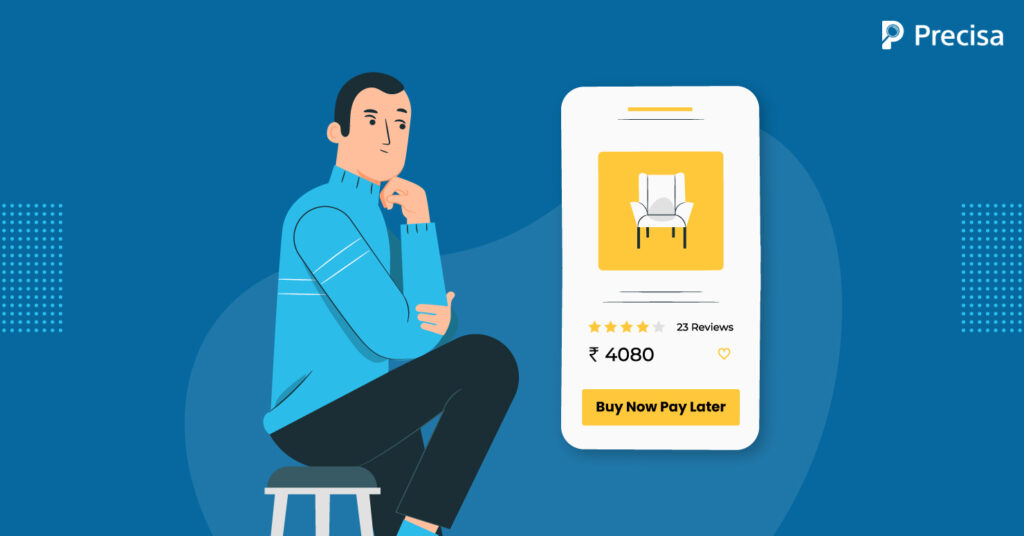
India’s payments market size is expected to grow to $ 10 Trillion in 2026, according to a report by Boston Consulting Group. With payments, Buy Now Pay Later, or BNPL, a newer trend is also projected to grow to a BNPL Gross Merchandise Value of $93.509 B by 2028.
Buy Now Pay Later or BNPL in India is a payment option that lets online shoppers purchase a product instantly while making a payment later. This is how it works – the consumer must sign up with a service provider offering this option, who then makes the payment on behalf of the buyer. The consumers must repay the amount to the BNPL service provider within the stipulated time frame.
In a way, BNPL in India is an alternative form of credit access and is being leveraged by those who are unable to get access to credit cards. It can be viewed as an inclusive opportunity for those seeking credit. Some experts are bullish on this trend and believe it has the potential to democratise credit access. Others believe it creates a false sense of security and access in consumers, making them susceptible to incurring more debt.
RBI’s new guidelines for BNPL in India
Earlier this year, in June 2022, the Reserve Bank of India issued a notification to ban fintechs without a banking licence from loading Prepaid Payment Instruments (PPIs) of their consumer bases with credit lines. These neobanks typically partner with a Non-banking financial company to secure credit and then disseminate it to their consumer bases as loans or a PPI top-up. This is a primary business model for fintechs, which rely on interest rates and late fees to turn a profit.
However, after receiving the notification, several fintech companies like Jupiter, EarlySalary and KreditBeehave halted their BNPL services. Some are contemplating shifting from the PPI model to credit cards.
Democratising credit or building false security?
The aim of fintechs is to democratise access to credit, which so far has been accessible only to those who are inside the organised banking system. Millions of people outside of the organised workforce, for instance, are unable to access credit cards.
RBI’s circular comes at a time when the regulator has apprehensions about the potential lack of due diligence on the part of BNPL issuers. Is this a positive step, or does it perpetuate the problem of credit access to an elite consumer audience?
Impact of Interest-free borrowing
The application process for accessing a credit card is still a discerning process. Companies assess one’s creditworthiness on multiple factors – salary, credit history, etc.
On the other hand, accessing BNPL in India hardly comes with any barriers. Hence, there has been significant adoption of this product by diverse profiles of users – self-employed professionals, students, homemakers, and gig workers, among others.
The use case is not merely to use BNPL in India for retail therapy. Many people leverage this service to purchase supplies for their businesses because they are unable to access loans. It could also be used for educational purposes or to purchase a mode of transportation to be able to reach work.
Potential hazards
While BNPL has opened up access, the trend of interest-free borrowing also has the potential to trigger a culture of overspending by consumers and, in turn, plummet millions of consumers into a cycle of debt.
The penalty levied on those who cannot pay their BNPL service provider within a stipulated period can grow to astronomical amounts quickly. The stipulated period is typically between 15 to 30 days. For many first-time borrowers, the discipline and habit of making payments on time are yet to be cultivated. They may also be unaware of the actual penalties or late fees being charged, as well as their payment cycles.
While these are the potential hazards for customers, BNPL also has the potential to trigger a financial crisis, which can quickly get out of hand. For instance, if millions of consumers leverage the service but cannot afford to make payments on time and consistently keep defaulting on payments, the fintechs, and their partner NBFCs, will be unable to recover their credit lines.
The Great Recession of 2008 grew on a foundation of debt. Failure to regulate financial products on the part of the regulators also played a massive role in the escalation of the crisis.
BNPL service providers will need to build a framework for vetting potential consumers. For instance, leveraging financial statement analysis software can help service providers study bank statements in minutes, bringing efficiency to the process.
Is a blanket ban on BNPL too harsh?
A blanket ban on BNPL in India diminishes the efforts of fintechs who have worked hard to build an alternative credit access model. Instead, some stringent guidelines must be put in place to safeguard the interests of both borrowers and BNPL service providers without taking away the core essence of accessibility from it.
Companies offering the BNPL must rethink their overall BPL strategies. For instance, there is a potential for sales teams to use predatory methods to acquire customers who may possess little financial capacity to make payments. However, it is easy to succumb to such an offering due to difficult personal circumstances without fully understanding what they are taking on.
Hence, efforts must also be made to educate consumers on the potential hazards of using the BPNL feature without having the financial integrity and capacity to make payments on time in a responsible manner.
Putting safeguards in place
The industry as a whole must come together to identify the best way forward before doing away with this product altogether or else evolving it to function as just another credit card.
Deserving consumers must not be left outside the credit access ecosystem, while companies cannot shy away from the hazards of indiscriminate lending.
The BNPL in India model will need to evolve to bring in best practices to sustain it as an inclusive financial access vehicle.
By leveraging financial statement analysis software, companies offering BNPL in India can vet thousands of potential consumers and successfully onboard them with speed and accuracy. This approach can make this innovative credit product a win-win for all stakeholders.
Check out our blog for more insights to help you make smart financial decisions.
 Mumbai