Mitigating Risks: A Lender’s Guide to Comprehensive Loan Portfolio Assessment
As of March 2024, the gross non-performing assets (GNPAs) ratio for scheduled commercial banks stands at 2.8%, a 12-year low, exhibiting an improvement in managing default risks.
Despite this, lenders must be continually wary of the impact of risky loans, as it is not just limited to the lending institutions’ profitability. It significantly undermines the confidence of the investors and heightens regulatory pressures.
Therefore, a comprehensive loan portfolio assessment along with a proactive risk mitigation strategy is essential to manage broader financial risks, including market fluctuations, liquidity challenges, and credit defaults.
This article will explore the specifics of loan portfolio assessment in the lending business, the risks involved, and how they can be tackled.
Understanding Loan Portfolio Assessment
Loan portfolio assessment involves developing a holistic risk mitigation strategy to analyse all the loan portfolios. The goal is to measure the inherent risks, which we will discuss in the next section.
Generally, it assesses various components, such as credit health, market trends, and operational efficiency in the loan process. Their understanding helps to improve the overall portfolio health for the stakeholders.
For instance, for a bank with a Rs 5 crore loan portfolio, an assessment based on credit scores and industry trends finds high-risk loans to be 20%. To improve its financial health, banks should reduce their high-risk loan exposure by 7% and increase low-risk loan allocation by 4%.
Loan Portfolio Assessment: Strategies for Handling Risks
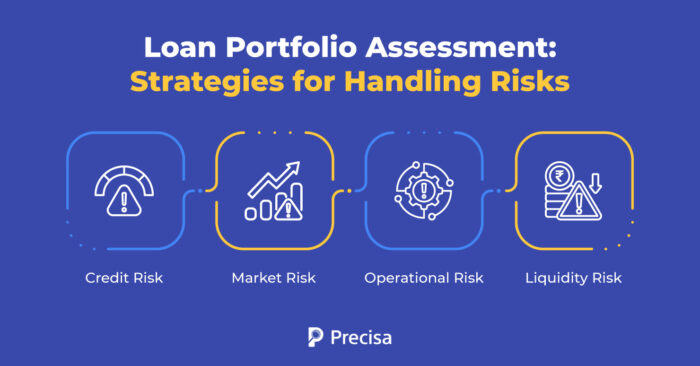
Now, let us understand the most critical risks and their mitigation strategies for an efficient loan portfolio assessment:
1. Credit Risk
It denotes a possibility that a borrower or a counterparty will not be able to meet its obligation as per the agreed terms.
For individual lending, the creditors focus on knowing the borrower’s financial situation—their assets, liabilities, income, and credit history. On the other hand, assessing credit risks in commercial lending requires various qualitative and quantitative techniques, such as:
- Industry trends
- Business environment
- Management strategies
- Owner’s credit scores
Tackling credit risks: Some strategies
Lenders can use a range of proactive strategies to mitigate credit risks. These include:
- Credit structuring: It includes offering credit terms as per the borrower’s perceived risk. For example, a shorter amortisation period for a high-risk borrower.
- Sensitivity analysis: This is a financial modelling tool via which lenders can assess the impact of changes in variables on loan portfolios.
- Portfolio-level controls: These involve monitoring and understanding the risk scores of borrowers and the proportions of credit type to anticipate risks better.
For instance, when the banks anticipated that the retail sector would face headwinds during the pandemic, they restricted high-risk profile loans and restructured existing loans.
2. Market Risk
Market fluctuations, including interest rates and currency changes, pose significant risks to loan portfolios. Tools like Value-at-Risk (VaR) can measure potential losses.
While complete elimination of market risk is impossible, strategies like interest rate swaps and currency hedging can mitigate its impact.
Further, loan portfolio diversification across various sectors and geographies can mitigate the impact of market risk and help better withstand market volatility.
3. Operational Risk
The complex interplay of stakeholders, systems, and processes in lending creates operational vulnerabilities. Increased digitisation has exacerbated risks like cyber fraud and system failures, necessitating robust risk management strategies.
For instance, Mahindra Finance faced Rs 150 crore fraud in its loan portfolio due to KYC document forgery.
Strategies to deal with operational risks
To mitigate operational risks, lenders can employ the following measures:
- Robust internal controls: Ensuring systems and processes are secure and efficient.
- Fraud detection mechanisms: Using artificial intelligence (AI) to detect unusual patterns and respond promptly.
- Regular audits: Helps identify gaps and improvement areas to ensure compliance with regulatory standards.
Financial institutions that have automated monitoring systems are better equipped with such risks.
4. Liquidity Risk
The inability to meet short-term financial obligations often leads to losses, impacting cash flow management, funding of new loans, and market trust, potentially causing bankruptcy.
Liquidity Risk can be managed using techniques such as:
- Duration gap analysis: Compare the duration of the assets and liabilities to understand the cash flow timeline.
- Liquidity risk management: This involves scenario analysis, stress testing, and thorough contingency planning, which helps identify vulnerabilities.
Steps for a Comprehensive Loan Portfolio Assessment
Now, let’s explore the steps to be followed for loan portfolio assessment:
1. Data Collection
Information regarding borrowers should be accurate and comprehensive, with collecting details such as:
- Financial history: Balance sheet, income statement, cash flow statement, and other reports as required.
- Credit history: Loan details, credit rating, employment details, etc.
- Market data: Information and trends of the loan application sector or industry.
Examining the accuracy and reliability of the data is necessary since they form the basis for the success of any loan portfolio assessment.
2. Risk Analysis
One can use statistical models and automated tools to predict potential losses under various scenarios. Artificial Intelligence (AI) models can be used to analyse risks using historical data and report more objectively and effectively.
3. Diversification of portfolio
Make sure to diversify the portfolio as it spreads the risk across various types of loans. This can withstand the fluctuations in the market better.
4. Reviewing and monitoring
Regularly monitor and review the loan portfolio to keep track of its performance and emerging risks. The adoption of business intelligence for continuous monitoring can significantly improve this process.
Loan Portfolio Assessment: Some Challenges
Several challenges plague the efficiency of loan portfolio assessment:
- Poor Quality of Data: Ensuring error-free, reliable, and updated information is crucial for accuracy. For example, Changes in the market need to be quickly accommodated in assessment.
- Precision in decision algorithms: Training data needs to be objective and bias-free.
- Compliance measures: Ensuring all regulations, guidelines, and specifications are aptly followed can be difficult.
- Time-consuming and expensive: Using manual processes for analysing loan portfolios is labour-intensive.
All these challenges can be addressed using automated decision-making tools for loan portfolio assessment. As they work on smart contracts, the assessment is fair and efficient.
However, they must be equipped with advanced data management systems and risk management frameworks. Also, human moderators are best suited to oversee the adaptability of these models.
Final Note
Loan portfolio assessment is crucial to mitigate risks in lending and ensure long-term sustainability for financial institutions.
Precisa is a cloud-based financial analytics platform that enables institutions to measure and manage the risk associated with their loan portfolios.
The platform offers user-friendly solutions like bank statement analysis, credit report analysis, and GSTR Analysis.
Users can directly upload their bank statements or fetch data directly from banks via an Account aggregator integration for quick and error-free services. The platform also provides real-time fetching of credit reports to get a holistic view of lender’s financial health.
Sign up for a free trial to know more!