Modern Bank Statement Terms: A Guide for Lending Professionals
Your underwriting team approved a ₹10 lakh loan yesterday. The bank statement showed stable income and salary deposits within the first week of the month. However, they missed a monthly withdrawal of ₹ 60,000 on the same date for six consecutive months. Is it something that requires further investigation, or does the account holder have a valid reason for this?
A comprehensive analysis of bank statements provides greater insight than credit scores alone, allowing structured risk assessment and spotting transactions like the one mentioned above. Lenders review key terms and data to evaluate financial stability, risk, and repayment capacity.
The discussion below focuses on the particular terms that lending professionals should pay attention to when reviewing modern bank statements.
Modern Bank Statement Terms That Matter
Understanding key terms and concepts included in modern bank statements is the key to interpreting the data effectively. Find out what these terms are and what they mean:
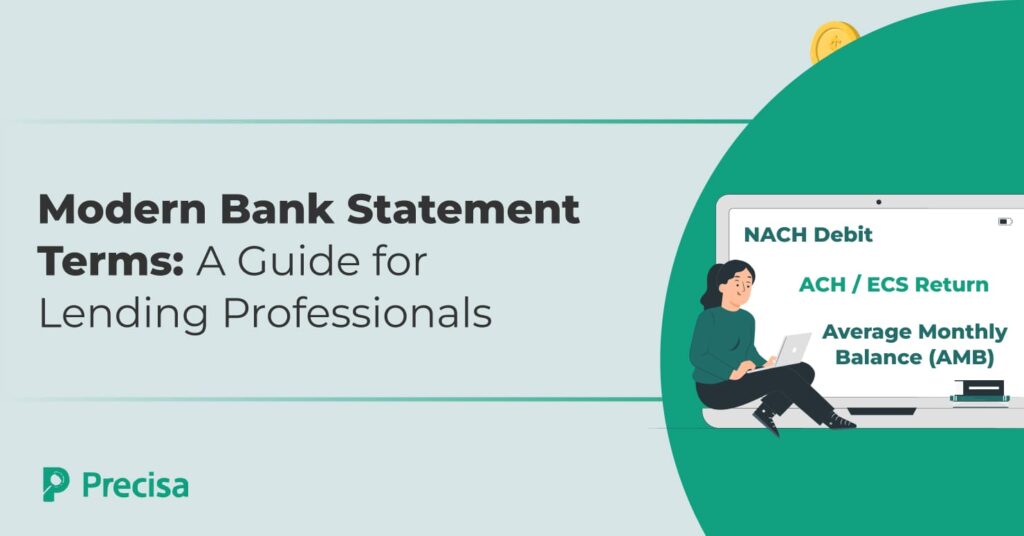
NACH Debit or Debit Mandate
These automated withdrawals represent recurring monthly debits such as EMIs, insurance premiums, subscriptions, and utility bills, and reflect an individual’s fixed financial commitments. But timing matters as much as amount. NACH debits are scheduled on the 5th, while salary credits on the 28th signal liquidity timing risks that can trigger cascading defaults.
Lenders analyse these debits to better understand the applicant’s liquidity by comparing regular outflows to inflows, helping them assess the applicant’s ability to manage ongoing obligations.
Precisa’s category-wise transaction summary automatically flags when NACH obligations exceed 55% of monthly income, the threshold where default risk multiplies.”
ACH/ECS Return
An electronic transaction sent back to the sender due to processing issues within the NACH system is marked as an ACH or ECS return. Two ECS returns in six months raise yellow flags. Four or more signal serious repayment issues, as this indicates that the applicant is unable to honour their monthly payment obligations and has a poor repayment history.
Precisa is designed to catch any type of irregularities in bank statements that are potentially fraudulent or indicative of poor credit health.
Lien Amount
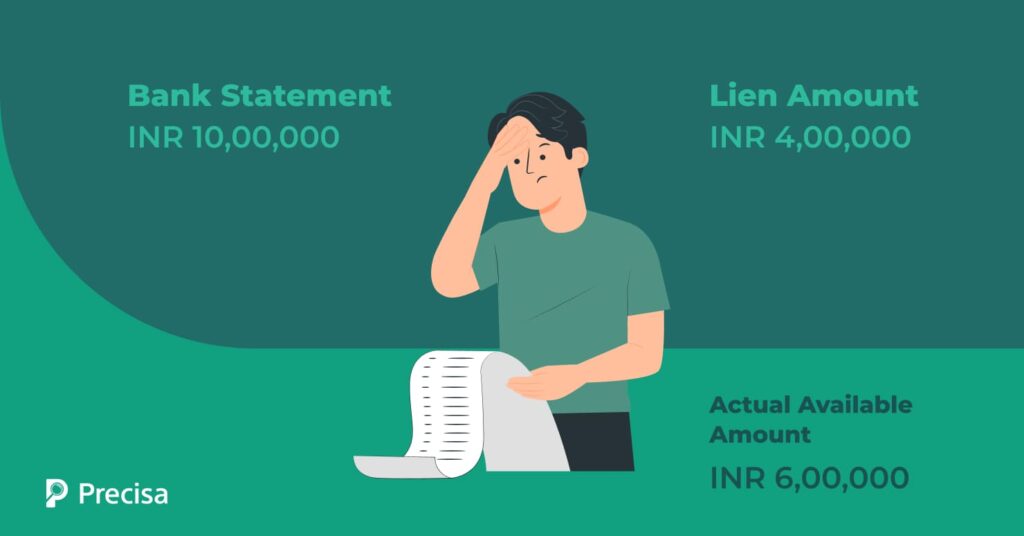
A lien is a temporary hold on funds and is typically associated with loans, penalties, or pending verifications. These are often due to existing security or legal requirements and reveal that the actual amount available to the statement holder may be less than the overall balance, which impacts the available borrowing capacity of the borrower.
For example, a bank statement may show Rs 10 lakhs as the balance, but if there is a lien of Rs 4 lakhs, the available balance is Rs 6 lakhs only.
Precisa’s balance analysis automatically factors liens into ABC calculations, preventing overleveraging approvals.
Average Monthly Balance (AMB)
Most banks require account holders to maintain an average monthly balance; failing to do so can result in charges and penalties. Lenders look at the AMB trend to assess the financial discipline and habits of the account holder. Consistent AMB maintenance over 12+ months correlates with disciplined cash management and is better than experiencing large, fluctuating, and unexplained deposits.
But what if the statement shows a sudden ₹5 lakh deposit on the 1st, withdrawn almost immediately? Trends and transactions like this can be missed in manual scrutiny, but not by the Precisa, which can flag over 20 irregularity types, including deposit-withdrawal symmetry.
Overdrafts
An overdraft facility allows account holders to spend beyond their available balance; it is essentially a short-term credit from the bank. Overdraft utilisation exceeding 80% of the limit for three consecutive months signals cash flow stress. If overdrafts are used to cover NACH debits, it indicates the applicant is borrowing to meet existing obligations and is already overleveraged. Precisa tracks ODCC (Overdraft/Cash Credit) utilisation patterns in the summary tab, highlighting when temporary credit becomes permanent dependency.
Bounced Cheques Charges
Banks levy charges when a cheque is dishonoured due to insufficient funds or technical reasons such as signature mismatch, overwriting, and so on. The frequency of these charges in the statement offers insights into the account holders’ financial habits. Two bounced cheques in six months is a cause of concern, and more than two, especially for utility payments, or amounts exceeding Rs 10,000, suggest that existing financial commitments exceed income capacity.
The Bounced Cheque Analysis tab isolates all inward and outward bounces with transaction dates, cheque numbers, and amounts, tracking patterns across months to distinguish one-time errors from systematic cash flow problems. The analysis offers lenders an accurate risk assessment and also behavioural insights.
Recurring Charges
Recurring charges are periodic debits, such as loan repayments, subscriptions, or service fees. For example, periodic debits: ₹8,500 to ‘Bajaj Finance’ on the 10th every month, ₹12,000 to ‘HDFC Life’ quarterly, ₹2,499 to ‘Netflix’ monthly, reveal obligations not captured in NACH mandates or credit reports.
The challenge here is that these are not always listed under a single term; transaction descriptions may vary (BAJAJ FIN, BAJAJ FINANCE LTD, BAJ FIN). Precisa’s recurring payment detection identifies these patterns in a modern bank statement, even when descriptions change, exposing undisclosed liabilities that inflate the borrower’s true debt burden.
Abnormal International Transactions
International transactions that deviate from the usual pattern of the account holder are a cause of concern. For a salaried employee working in India and getting a monthly salary of Rs. 70,000, multiple international transfers totalling lakhs in a month raise questions.
Similarly, funds received from abroad and transferred domestically almost immediately could signal potential money laundering activities.
The AML Analysis dashboard tracks cross-border fund flows and flags suspicious patterns with visual money trail mapping, helping lenders spot risks before they become regulatory nightmares.
Detecting abnormal transactions in real-time, such as repeated international transactions or swift fund movements across multiple accounts, can also help lenders prevent money laundering.
How Automated Bank Statement Analysis Saves You Money And Improves Profits?
Manually searching for suspicious patterns or transactions in a modern bank statement is a tedious and time-consuming task. Additionally, identifying patterns or spotting all red flags by sifting through thousands of transactions across multiple bank statements that a person may provide for analysis is almost impossible.
This is why lenders need automated bank statement analysers; trusted partners that offer comprehensive, accurate insights in minutes. Find out how automated analysers support lenders in their risk assessments.
Help Improve Portfolio Quality
Automated statement analysis tools can spot patterns that humans can’t, such as circular transactions. Missing irregularities and money laundering activities can make lenders susceptible to losses, and loans can become NPAs.
For example, when five different borrowers all show regular transfers to the same entity, manual reviewers checking statements individually won’t catch the connection. In such cases, Precisa’s counterparty visualisation maps these relationships automatically, flagging potential collusion or concentration risk. This prevents the portfolio clustering that turns one default into five simultaneous NPAs.
Improved Productivity
Manual review can take days or even weeks. However, when a leading Bengaluru DSA started using Precisa, the processing time reduced from 2 hours per application to 30 minutes, enabling them to process 4X more applications with the same team.
Similarly, a forensic audit firm reduced investigation time from 30-45 days to 25-30 minutes for complex money trail analysis. In competitive lending markets, responding 48 hours faster often means winning the customer before competitors even finish their review.
Standardised Decision Making
Human review may yield varied analyses of an identical bank statement, which is due to inherent bias and variations in assessment patterns. For instance, two underwriters reviewing identical statements might interpret a ₹1 lakh deposit differently. One flags it as suspicious. Another sees it as a bonus payment. Manual review creates this inconsistency.
Precisa applies consistent logic every time: Is the deposit recurring? Does it match employment patterns? Is the timing suspicious relative to the loan application? Precisa’s Volatility Score (0-1 range) quantifies cash flow stability – scores above 0.7 indicate erratic income patterns that correlate with higher default risk.
The Precisa Score synthesises multiple risk signals into a single creditworthiness metric, removing subjectivity from underwriting decisions.
To Sum It Up
Modern bank statements reveal what credit scores cannot. However, manual analysis cannot match the volume and sophistication of modern lending. Automated bank statement analysis empowers lending professionals to make well-informed, responsible decisions, recognising patterns that signal financial health or predict defaults.
Precisa Bank Statement Analyser translates detailed statement insights into actionable lending strategies. Trusted by 1000+ clients across 25+ countries, Precisa processes 1200+ bank formats and handles 51 crore+ transactions.
See what your underwriters missed in their last 100 approvals. Start your free trial now.