Dormant Account Activation: What Sudden Activity Signals in AML Screening

Financial criminals rarely announce their intentions. They exploit gaps in monitoring systems, and one of their preferred entry points is dormant bank accounts that suddenly spring to life after years of inactivity.
As of the latest available data, unclaimed deposits in Indian banks stood at ₹78,213 crore, reflecting persistent challenges in dormant account monitoring. When these accounts reactivate unexpectedly, they often signal money laundering, identity theft, or structured transaction schemes that manual monitoring struggles to catch in time.
The challenge is not just volume. It is recognising what sudden activity truly means when an account that has been silent for years begins moving large sums within days of reactivation.
What Qualifies as Dormant Account Activation
The Reserve Bank of India classifies bank accounts as inoperative after 10 years of no customer-initiated transactions.
This means no deposits, withdrawals, or fund transfers triggered by the account holder during that period.
Under RBI’s 2024 instructions, banks must implement enhanced monitoring of all activity upon reactivation. This includes scrutinising the nature, frequency, and value of transactions to detect potential AML risks like sudden high-value transfers or beneficiary changes inconsistent with the account’s historical profile.
The concern is straightforward. Criminals acquire access to these dormant accounts through identity theft, document fraud, or purchasing compromised credentials. Once reactivated, the accounts become vehicles for layering illicit funds through seemingly legitimate banking channels.
The ₹78,213 crore in unclaimed deposits represents not just dormant wealth, but dormant risk. Each reactivated account without proper scrutiny becomes a potential entry point for financial crime.
5 Key Red Flags That Signal AML Risk
Dormant account reactivation itself is not inherently suspicious. Genuine customers do reactivate old accounts for legitimate reasons. The problem arises when the activity following reactivation deviates sharply from expected patterns.
1. Sudden High-Value Transactions
An account dormant for eight years suddenly receives ₹15 lakh within 48 hours of reactivation. Within 72 hours, ₹14.5 lakh is transferred out through multiple RTGS transactions to previously unknown beneficiaries. This velocity and volume mismatch against historical behaviour is a classic money laundering indicator.
2. Rapid Fund Movement (FIFO Patterns)
First-In-First-Out (FIFO) behaviour is when large deposits are followed almost immediately by near-equivalent withdrawals. The account functions purely as a transit point, not a genuine banking relationship. In dormant account scenarios, FIFO patterns post-reactivation strongly suggest structuring or layering activity.
3. Multiple Beneficiary Additions
A reactivated account that adds five new beneficiaries within days and immediately initiates transfers to all of them raises questions. Why would a dormant customer suddenly establish complex payment relationships without gradual account usage?
4. Geographic Inconsistencies
If the account was opened in Mumbai, remained dormant for a decade, then reactivated with transactions originating from Kolkata and beneficiaries in Chennai, the geographic scatter warrants investigation. Genuine reactivation typically shows consistency with the customer’s known location.
5. Transaction Types Inconsistent with Profile
A salary account that lays dormant and reactivates with cash deposits, international wire transfers, and trading account links behaves nothing like a salary account. The transaction types should align with the account’s original purpose and the customer’s documented income sources.
These patterns require systematic bank statement analysis to detect consistently across high volumes of reactivated accounts.
Why Manual Monitoring Cannot Keep Pace

Compliance teams at banks and NBFCs face an impossible task when relying on manual review of reactivated dormant accounts.
When even a small percentage of these accounts reactivate monthly, manual review backlogs become inevitable. Manual teams cannot examine every reactivated account with the depth required to catch sophisticated schemes.
Humans excel at recognising obvious anomalies (a ₹50 lakh deposit in a zero-balance account is easy to spot). But layered patterns involving multiple small transactions, counterparty connections across accounts, and time-distributed fund movement slip through manual review.
By the time a compliance officer manually reviews a flagged dormant account, identifies suspicious FIFO behaviour, and escalates it, several days or weeks have passed. The funds have already moved through multiple accounts, and the money trail has grown cold.
If a fraudster reactivates three dormant accounts and rotates funds between them before moving money externally, manual review of individual accounts misses the circular transaction pattern. The risk only becomes visible when analysing all three accounts simultaneously.
How Precisa Detects Dormant Account Risks
Automated bank statement analysis transforms how compliance teams handle reactivated dormant accounts. Precisa platform, trusted by 1000+ clients across 25+ countries, detects these exact patterns within minutes of processing. The system is designed specifically for AML compliance teams managing reactivated dormant accounts.
FIFO Tracking
Precisa maps first-in-first-out transaction sequences, highlighting accounts where large deposits are followed by near-equivalent withdrawals within unusually short timeframes. The visual representation shows exactly how much money entered, how quickly it exited, and to whom it went.
Multi-Account Analysis
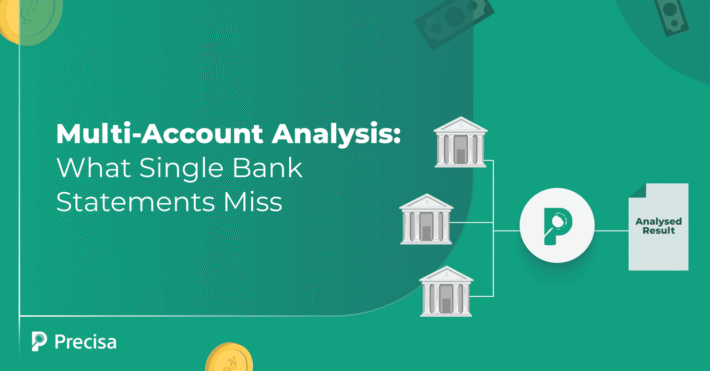
When uploading multiple bank statements, Precisa cross-references transactions across all accounts simultaneously. If funds are moving circularly between reactivated dormant accounts, the system detects and maps these inter-account transfers, revealing the complete money trail that single-account reviews miss.
Suspicious Pattern Recognition
The platform automatically flags 14+ AML risk indicators, including cash deposits on bank holidays, balance versus computed balance mismatches, and high-value transactions inconsistent with account history. For reactivated dormant accounts, these automated checks run instantly.
Visual Money Trail Mapping
Precisa generates graphical representations of fund flows, making it immediately clear where money originated, which accounts it passed through, and where it ultimately landed. This visualisation is particularly valuable when presenting findings to investigators or regulatory authorities.
Counterparty Detection
The system identifies all parties involved in transactions and calculates total amounts exchanged with each counterparty. If a reactivated account is funnelling funds to a specific entity through structured payments, Precisa surfaces this relationship automatically.
These capabilities allow compliance teams to process reactivated dormant accounts in 25-30 minutes instead of the 30-45 days typical for manual forensic investigations. The speed advantage means suspicious activity is caught before funds dissipate, and STR (Suspicious Transaction Report) filings happen within regulatory deadlines.
Conclusion
Dormant account reactivation will continue to be an AML risk vector as long as criminals seek methods to layer illicit funds through banking systems. The ₹78,213 crore in unclaimed deposits represents both dormant wealth and dormant vulnerability.
RBI’s enhanced monitoring mandates for 2026 recognise this reality. But compliance is only achievable when technology matches the sophistication of the schemes being deployed.
Automated analysis transforms dormant account monitoring from a reactive, backlogged process into proactive risk detection. Pattern recognition that would take days manually happens in minutes, and suspicious activity surfaces before it escalates into regulatory breaches.
Ready to see how automated AML analysis works? Try Precisa for free