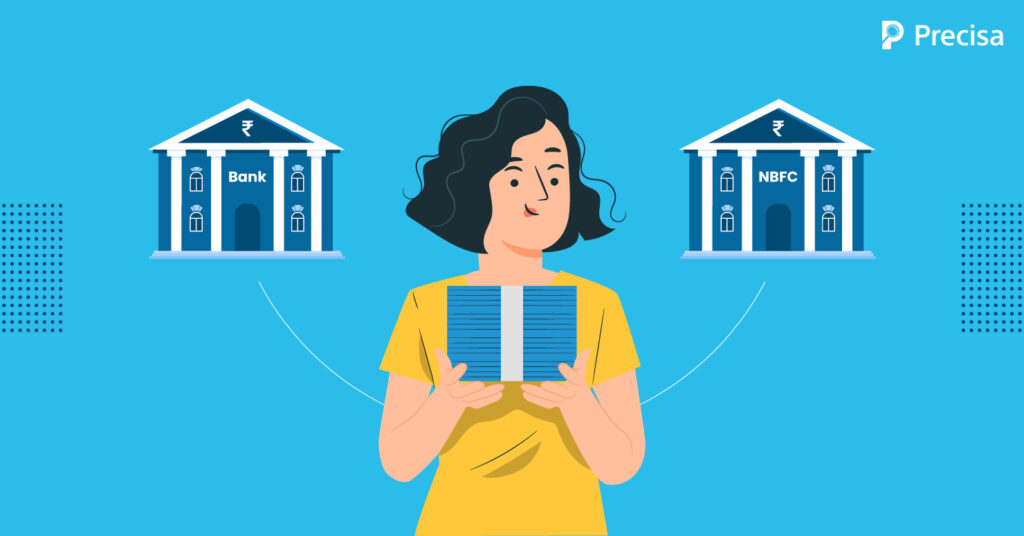
From the co-origination of loans in 2018 to the ‘co-lending model’ of 2020, the evolution of the framework laid out by the Reserve Bank of India (RBI) has spurred banks-NBFCs collabs. This has allowed for seemingly unusual tie-ups between banks and fintech companies and has raised concerns over the model’s sustainability and reliability. We’ll take you through the model, its goals, and proposed benefits, as well as the possible risks it could entail.
The ABCs of the Co-Lending Model
Here we take you on a vis-a-vis with the new lending model:
What is co-lending or CLM?
The newly rebranded ‘CLM’ is a modified version of RBI’s 2018 loan co-origination scheme, amended to include Housing Finance Companies (HCFs) under the umbrella term of Non-Banking Financial Companies (NBFCs).
Simply put, CLM permits the banking and non-banking sector to jointly disburse loans, so that both lenders in conjunction can improve credit flow to underserved sectors at affordable rates.
This means that NBFCs and banks share both the risks and rewards of the venture. A recent example is a partnership between Bank of Baroda and U GRO Capital, an SME finance NBFC.
What is the typical lifecycle of such a loan, and what are the T&Cs?
The co-lending model runs on pooling resources available to both the bank and the NBFC. Typically, due to the larger bandwidth of NBFCs in priority sectors, these firms take on loan origination responsibilities and become the customers’ sole point of contact.
NBFCs find potential clients and refer them to banks, where vetting, requirement analysis, and risk assessment take place. A tripartite agreement is signed if the client meets all requirements between lenders and the borrower.
Funds are disbursed from a common escrow account, wherein each lender must allocate and collect the funds as per the ratio decided in the master agreement.
Also read: Why Data and Automation is the Future of SME Lending
RBI stipulates that the risk share be 80:20, 80% with banks, and at least 20% with non-banks. Furthermore, loan provisioning must be independent when a partner bank cannot fund NBFCs to provide their loan portion. Additionally, each lender may set their interest rates; hence borrowers pay a ‘blended interest rate’.
What does the CLM hope to achieve?

While NBFCs boast the impressive reach that banks lack in providing loans to SMEs and underserved sectors, these non-banks often face the pinch of a shallow pocket.
Contrastingly, bank balance sheets are flush with funds, but they struggle to meet Priority Sector Lending (PSL) requirements. The co-lending model is a quid pro quo arrangement that hopes to simultaneously provide NBFCs with the much-needed funding while banks leverage this newfound reach into a previously unreachable, ignored, and untapped client base.
What purports itself to be a symbiotic relationship between traditional and non-traditional lenders also promises to benefit borrowers. Larger credit lines, lower interest rates, and faster disbursal are set to make the loan process easier for clients.
Additionally, banks are eager to reduce turnaround times with the fintech risk assessment, monitoring, and mitigation used by NBFCs.
Why does the CLM raise concerns and pose risks to economic health?
The co-lending model is an ambitious play toward revolutionising the face of credit lines in India, but the stakes are high, and eyebrows are raised even higher in question.
High risks for banks coupled with the NBFC crisis
With the onset of the NBFC crisis and the failing of shadow-banking firms such as IL&FS and DHFL, the $370 billion mistakes crippled the sector and exposed a faulty business model and fairly poor asset quality.
Also read: All You Need to Know About the Four Levels of Digital Lending
As a result, confidence is at an all-time low in these firms that borrow short-term but lend long-term. Hence, the co-lending model seems to be a disguised bailout for NBFCs, the RBI’s attempt to make available funds.
However, with banks already battling the problem of Non-Performing Assets (NPAs), and having to take on 80% of the loan burden in the CLM, there are worries that this model is not suitable nor sustainable in the long term.
NBFCs still possess inherent flaws, which could spell doom for partner banks when coupled with a gross imbalance of assets and liabilities.
Ground-level execution and IT readiness
Even when not considering risk factors and a dwarfed market confidence, the co-lending model simply has too many moving parts which need to fall into place perfectly 100% of the time to be successful.
From the nascent stage to the creation of a tripartite agreement, the co-lending model will test the agility of both parties and could engender teething severe problems that impact the customer.
The CLM would be dependent on the seamless multidirectional flow of data between all parties and the robustness of technological solutions.
Automated data-based decision-making technologies will be the key in reducing errors and supporting successful collaborations. Furthermore, risk assessments, compliance checks, and capital adequacy and assessments would need to be standardised to integrate the different methods of underwriting used by banks and NBFCs.
While the co-lending model itself may be polemic, what is certain is that today’s economic climate demands robust IT solutions for crucial and time-sensitive steps in the loan disbursal process. Precisa’s Bank Statement Analyser fulfils this requirement by offering quick, accurate, and automated statement analyses to help decide creditworthiness.
 Mumbai