The market size of the digital lending industry in India was worth just $ 9 billion in 2012. By the end of 2023, it is projected to reach a value of $ 350 billion.
Fintech companies have played a major role in the accelerated growth of digital lending, and in particular, small business financing. The innovative role of technology has transformed the lending process, making it a seamless, expedited one, thus enabling digital lenders to gain more market share.
Retail customers as well as Micro, Small & Medium-Size enterprises (MSMEs) have largely benefited from the shift.
However, one challenge that remains is the ability of fintech companies to assess the creditworthiness of borrowers and potential risks, accurately. In March 2021, for instance, the highest share of non-performing assets (NPAs), at 16.8 %, was of the medium enterprises. The overall NPAs for MSMEs stood at 12.5 % for Financial Year 2021.
In this blog, we delve into how fintech companies can leverage Goods & Services Tax Return (GSTR) Analysis as one of the data points to assess a borrower’s risk profile with speed and accuracy.
Risk Assessment Challenges for Fintech Companies
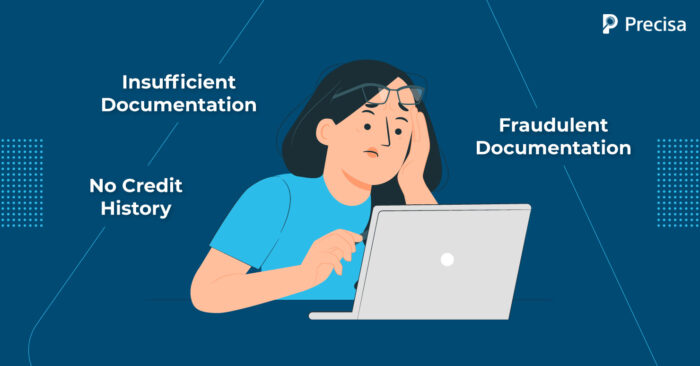
Here is a snapshot of common challenges faced by fintech companies while assessing the risk profile of potential borrower enterprises:
Insufficient Documentation
Many loan applications tend to be incomplete. They may not have enough data points for fintech companies to come to a decision about their applications. When they request for more documentation, it may take time to collect the documents, leading to drop-offs.
Fraudulent Documentation
Loan fraud is one of the largest categories on the financial fraud spectrum. Fraudulent paperwork is often the genesis of such frauds, and they often take many years to unravel. Hence, fintech companies need to ensure that they go to great lengths to verif,y beyond doubt, the authenticity of documents, when making underwriting decisions.
No Credit History
Many borrowers do not have any credit histories as they have been denied loans in the past. Hence, first-time loan applicants may not have the creditworthiness required to get a loan. Fintech companies seek to be more inclusive and identify alternative data points, in such cases.
What is GSRT Analysis?
Goods and Services Tax or GST, is a type of indirect and unified tax levied by the government on the sale of goods and services. The tax structure is standardised across the country and set by the central government in consultation with states.
GST comprises a mix of CGST (Central GST), SGST (State GST), and IGST (Integrated GST). Businesses need to file GST returns (GSRT), which comprise details of all sales invoices (including credit-debit notes) raised.
Fintech companies can now access GST returns as an additional and reliable data point, to help determine the creditworthiness of a potential borrower business.
A thorough GSTR analysis yields legitimate information, as to the monthly sales and revenues of the business. It paints a picture of the monthly fiscal health of the business.
A company’s GST information can be accessed from the Government’s GST portal along with the return filing history. The borrower (or taxpayer) must give their consent via OTP authentication.
Borrowers can also share data via PDFs or spreadsheets, but these are susceptible to data tampering. The best approach is to get GST data directly from the sources i.e. to the GST portal.
5 GSTR Analysis Benefits For Fintech Companies
Credible Data, Reduced Risk
Data directly received from the source i.e. the GST portal is generally considered to be authentic. In the face of growing concerns about document forgeries, access to GSTR data eliminates an additional layer of concern for fintech companies.
Expedited Processes
When loans are based on GSTR analysis, there are also limited calculations involved. Fintech companies can turn such financial data into assessment data that is ready to analyse, with ease. Hence, the entire underwriting process, and in turn, the loan approval process, can be expedited.
Reduced Cost Of Doing Business
The amount of operational work required by MSME borrowers, as well as fintech companies, to accumulate adequate financial data is greatly reduced in one stroke. By focusing on producing GSTR data, MSMEs can reduce internal loan documentation-collection efforts. On the other hand, fintech companies can reduce efforts in follow-ups for multiple documents.
Advantage for MSMEs
Smaller-size businesses, with an inadequate credit history but which have a steady flow of revenues, can especially benefit from the GSTR-based loans. They can demonstrate their potential to repay a loan as GSTR information offers an authentic picture of fiscal health.
Customer-centric Lending
The best advantage by far is that fintech companies can deliver more value to borrowers, which is in line with their aim to disrupt the existing credit models and make lending more relevant to MSMEs. By getting access to GSTR in data, not only can fintech companies gauge the creditworthiness of the business. They are in a position to design customised loan offerings best suited to a borrower’s needs, with competitive interest rates.
The Takeaway
Despite the technological advances spearheaded by fintech companies, the inability to accurately predict potential risk profiles can result in a rise of non-performing assets, fraud, and other consequences.
At the same time, fintech companies are on a mission to build an inclusive landing ecosystem that is accessible to underserved segments and turn these segments into valuable customers.
Leveraging GSTR analysis in the underwriting process allows digital lenders to add a legitimate data point to the existing data pool. This is an effective way for them to gauge and cross-check the revenues of a business.
Additionally, by leveraging tools such as financial statement analysis software, they can further expedite the accuracy and speed at which loan applications can be processed. In turn, deserving MSMEs can access credit and fuel the growth of the Indian economy as it strives for the $5 trillion benchmark by 2026-2027.
Presica’s comprehensive and seamless financial data analysis solution simplifies and speeds up the process through automation. The software provides actionable insights on a customisable dashboard, thus helping companies make informed business decisions.
Request a free demo today!
 Mumbai