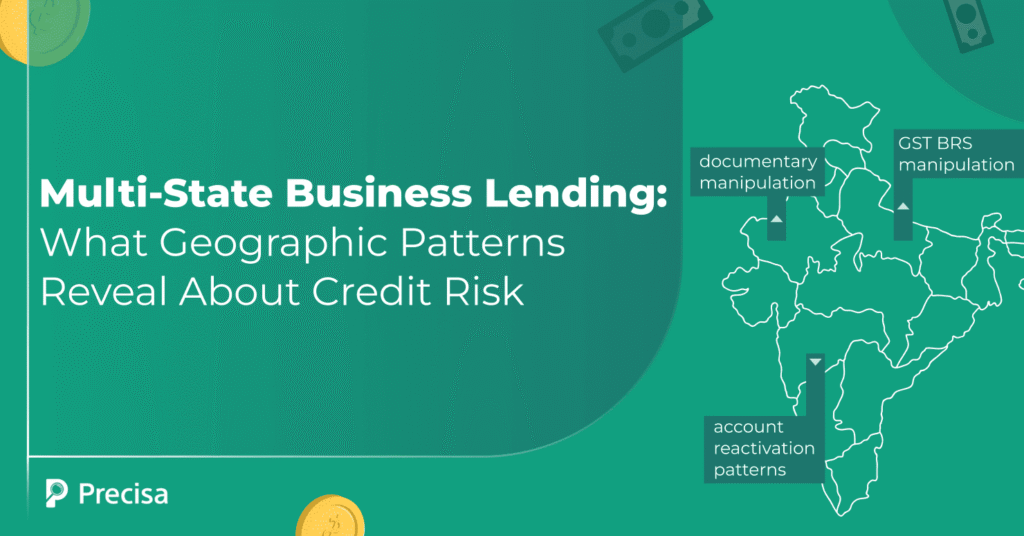
Multi-State Business Lending: What Geographic Patterns Reveal About Credit Risk
Your underwriter approved a Mumbai trading firm in 48 hours. Clean documents, stable cash flow, CIBIL score of 730. Eight months later, it’s restructured. The Jaipur application you rejected last week? Your competitor funded it, and it’s performing.
Same underwriting model. Same credit policies. Different states, different outcomes.
India’s ₹46 lakh crore small business credit portfolio spans 7.3 crore active loan accounts across vastly different fraud ecosystems. NBFCs compete on 48-hour approvals whilst traditional banks take 15-20 days. But speed without geographic intelligence creates blind spots. When your loan book spans multiple states, you’re not managing one risk profile. You’re navigating distinct fraud ecosystems, each with different signatures.
The question: Does your credit assessment adapt to these geographic realities, or does it treat a Mumbai manufacturer the same as a Jaipur trader?
How Geographic Fraud Patterns Impact Multi-State Lending Risk
Most lenders segment risk by industry, ticket size, or credit score. Few segments by geography. Fraudsters exploit this gap.
Consider two business loan applications. Both show ₹50 lakh annual turnover. CIBIL scores around 720. Six months of bank statements. Your scoring model rates them identically.
But one operates in a state where circular transactions between shell entities are common. The other is in a region where cash-heavy businesses dominate, and bank statement manipulation is prevalent. Your uniform risk model misses this context.
The result? Approvals that look identical on paper perform very differently in reality. One repays on schedule. The other restructures within eight months.
Geographic fraud patterns aren’t theoretical. Banking sector losses hit ₹101.82 crore in FY 2024-25. But the concentration reveals the pattern. Maharashtra accounted for ₹27.44 crore, Uttar Pradesh ₹19.08 crore, and Haryana ₹10.26 crore. Three states represent 56% of documented banking fraud losses.
Yet broader financial fraud losses across all categories reached ₹19,812.96 crore in 2025. The gap between detected and undetected fraud continues widening, particularly in multi-state portfolios where fund flows cross jurisdictions.
Tier 1 vs Tier 2 Cities: Different Fraud Signatures

Metro applications from Delhi, Mumbai, or Bangalore typically show sophisticated layering. Multiple accounts, complex fund routing, professional document preparation. The fraud is harder to spot but leaves digital trails when you know what to track.
Tier 2 and Tier 3 city applications lean towards simpler manipulation. Forged bank statements, backdated invoices, and cash deposit structuring. Less sophisticated, but volume-based. Your verification needs to catch both.
The Financial Intelligence Unit identified ₹11,000 crore in undisclosed income during 2024—attaching ₹2,763 crore in criminal proceeds and ₹983.4 crore in assets. Geographic distribution wasn’t uniform. Detection patterns revealed concentration in specific corridors where cross-state fund movement masked origins.
When your portfolio spans these geographies, your risk assessment needs dual capability: sophisticated pattern recognition for metro fraud and volume-based anomaly detection for smaller cities. Multi-state operations amplify these challenges through cross-jurisdictional fund flows.
The Cross-State Fund Flow Problem
Multi-state operations create verification gaps that fraudsters exploit systematically.
The Layering Strategy
Your borrower operates a manufacturing unit in Gujarat with accounts in two local banks. Purchase payments flow to suppliers in Maharashtra and Rajasthan. Working capital moves through a Chennai account. GST registration spans three states.
Manual verification checks the Gujarat accounts, confirms the business exists, and approves the loan. What it misses: The Maharashtra supplier is a related entity. The Rajasthan vendor address is residential. The Chennai account shows fund parking, not working capital deployment.
Consolidating accounts from multiple states used to take days of manual Excel work. Automated analysis now tracks inter-bank transfers and maps counterparty relationships across borders in seconds.
Where Manual Review Fails in Multi-State Portfolios
Your credit team reviews 40 applications daily. Each requires:
- Bank statement verification (30-45 minutes).
- CIBIL check and analysis (15 minutes).
- GST return review if available (20 minutes).
- Business verification calls (10-15 minutes).
That’s 75-95 minutes per application under ideal conditions. Multiply by 40 applications, and you’re at 50-63 man-hours daily. Most teams don’t have that capacity, so corners get cut.
Geographic risk assessment? It doesn’t happen. Cross-state fund flow tracking? Impossible manually. Counterparty relationship mapping? You’d need dedicated forensic analysts.
Automation doesn’t replace human judgment. It handles the pattern detection and data reconciliation that humans cannot do at scale, freeing underwriters to focus on actual credit decisions.
Asset Quality Deterioration: The Geographic Component
Gross bad-loan ratios are projected to rise from 2.6% (September 2024) to 3% (March 2026) under baseline scenarios. Unsecured lending accounts for 51.9% of new retail NPAs.
But when you segment NPAs by borrower geography, patterns emerge. States with higher cash economy penetration show different stress signals than those with formal banking dominance. Coastal trading states display distinct patterns compared to landlocked manufacturing regions.
Your credit model doesn’t capture this. It treats geography as a data point, not a risk variable.
Here’s what changes when geography becomes a dynamic risk factor, not a static field.
What Automated Multi-State Credit Risk Analysis Looks Like
Effective multi-state lending requires three capabilities most lenders lack:
State-specific Fraud Pattern Recognition
Your system should automatically apply different verification intensity based on the applicant’s operating geography. Not just location, but the specific fraud patterns prevalent in that region.
Cross-jurisdiction Fund Flow Tracking
When bank statements show interstate transactions, analysis should map the complete trail. Account Aggregator integration provides real-time access to multi-bank data, eliminating the gaps that manual document collection creates. This connectivity removes documentary fraud risk entirely—data comes directly from source systems.
Real-time Regulatory Data Cross-verification
Combining bank statement analysis with GSTN data reconciliation catches revenue inflation instantly. Manual review takes hours per application. Automated cross-analysis completes it in seconds.
Making Geographic Intelligence Actionable
The lenders succeeding in multi-state expansion share common characteristics:
- They’ve moved from document verification to data analysis. Instead of checking if bank statements are submitted, they analyse what the transactions reveal about fund sources, deployment patterns, and counterparty relationships.
- They’ve automated state-specific risk checks. Applications from high-fraud-concentration regions trigger deeper verification automatically, without manual intervention.
- They’ve integrated real-time data access. Account Aggregator connectivity eliminates documentary fraud by pulling data directly from source systems.
- They catch fraud patterns at origination that others discover at the NPA stage.
The competitive advantage in multi-state lending isn’t approving faster. It’s approving accurately whilst maintaining speed. That requires automating the geographic risk analysis manual processes, which cannot scale.
Precisa’s 1000+ clients across 25+ countries process 1.5 million bank statements monthly, across 850+ banks in 1200+ formats, analysing 510 million transactions that reveal geographic fraud patterns manual review would miss.
Most lenders discover these blind spots only after their NPA numbers spike. Don’t wait for the restructuring request.
Upload one multi-state application. See what cross-state fraud patterns Precisa catches in 30 seconds. Try Precisa for free now!