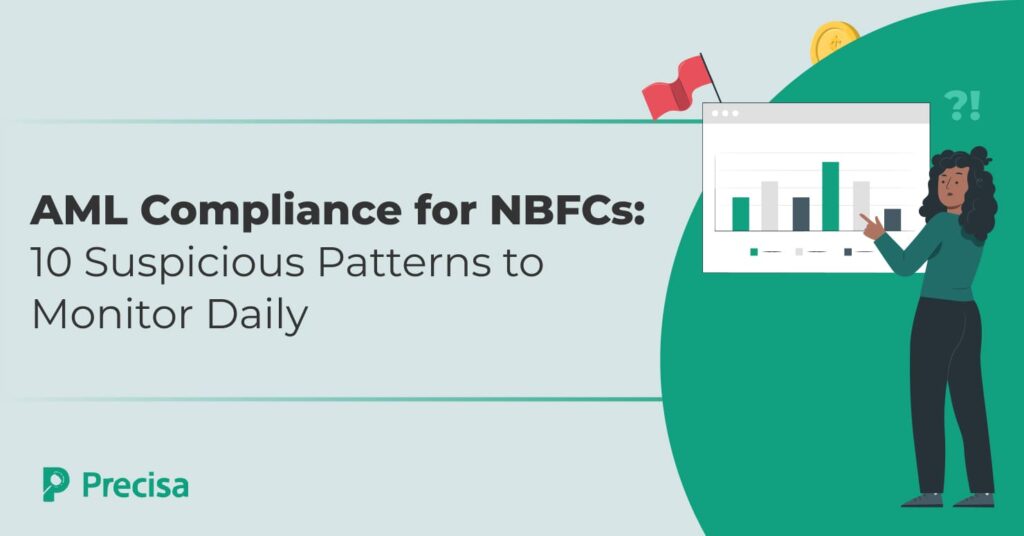
AML Compliance for NBFCs: 10 Suspicious Patterns to Monitor Daily
NBFCs today operate in a lending environment where financial crime risks evolve faster than traditional controls. Regulators expect institutions to demonstrate continuous monitoring, documented controls, and proactive reporting.
The FIU-IND received 4,36,287 STRs in FY 2022–23, highlighting how widespread suspicious activity continues to be across the financial system.
Against this backdrop, NBFCs must go beyond KYC formalities and CTR/STR filing cycles. Daily transaction behaviour often reveals the earliest signs of laundering, identity misuse, or fund layering.
This article outlines 10 critical suspicious patterns NBFCs should track every day to strengthen AML readiness and reduce regulatory and portfolio risk.
Why Continuous AML Compliance Monitoring Is Critical for NBFCs
NBFCs operate in diverse segments—MSME credit, gold loans, microfinance, housing finance, consumer credit, and co-lending. This makes them especially vulnerable to:
- Layering of illicit funds
- Use of loans as a channel for placement or integration
- Synthetic identity fraud
- Money movement through borrower networks
- Trade-based laundering through inflated invoices
RBI’s Master Directions on KYC mandate NBFCs to employ risk-based monitoring, ongoing due diligence, and automated systems that capture unusual behavioural patterns. Failure to do so can lead to:
- FIU-IND penalties
- STR/CTR reporting lapses
- Reputational loss
- Funding restrictions
- Greater NPA risk
Monitoring the right patterns daily is therefore non-negotiable.
10 Suspicious Patterns NBFCs Must Monitor Daily
The following 10 transaction behaviours may appear routine but are among the earliest indicators of laundering, fraud, or compliance breaches that NBFCs must detect daily:
1. Frequent Cash Deposits Just Below Reporting Thresholds
A common structuring technique is depositing cash just below the CTR threshold of ₹50,000 to avoid detection.
NBFCs should flag:
- Repeated deposits of ₹49,500, ₹49,000, etc.
- Sudden increase in such activity
- Deposit patterns inconsistent with declared income
This behaviour, time and again, indicates deliberate evasion and early-stage money placement.
2. Sudden Activity in Dormant or Low-Activity Accounts
Sudden spikes in a borrower account that previously showed little to no activity break expected behavioural patterns and may indicate:
- Possible account compromise
- Use of the account as a money mule
- Short-term placement of illicit funds
NBFCs should validate fund legitimacy, run EDD checks, and verify customer identity authenticity.
3. Loan Repayments from Third-Party Accounts
Repayments routed through non-borrower accounts may suggest:
- Trade-driven laundering
- Misappropriated customer identities
- Recycling of the same funds
- Criminal intermediaries clearing instalments
RBI rules require NBFCs to examine repayment origins for high-risk profiles.
4. Immediate Closure or Prepayment Using Large Cash

Large cash-based loan closures soon after disbursal often signal attempts to convert illicit funds into legitimate repayments.
NBFCs should closely assess:
- The source of such cash
- Whether the customer profile supports this liquidity
- If similar patterns appear across connected accounts
This behaviour frequently indicates layering activity.
5. Transaction Patterns Inconsistent with Customer Profile
When borrowers transact in ways that contradict their stated income or occupation, NBFCs must treat it as a red flag.
For example:
- Salaried borrowers showing MSME-like turnover
- Microfinance customers suddenly moving large sums
- Gold-loan borrowers making outward transfers
6. Multiple Loan Applications Using Shared Documents or Contact Details
Clusters of applications using overlapping credentials often indicate organised fraud rings. Watch for:
- Same phone number across unrelated applicants
- Several PANs tied to one device ID
- Repetitive document use with slight edits
They usually point to mule networks or synthetic identities.
7. Rapid Credit Turnover Without Clear Economic Purpose
A key indicator of layering is when funds are withdrawn, transferred, or cycled rapidly:
- Within minutes or hours
- In circular patterns
- Without a clear business rationale
NBFCs should review relationship mapping and transaction beneficiaries.
8. Discrepancies in GST Filings vs. Bank Statements
A major portfolio risk is inflated turnover in GST returns, while bank statement inflows tell a different story.
Daily monitoring should flag:
- Inflated outward supplies
- Inconsistent GST vs. banking cashflows
- High ITC claims without proportional business activity
This prevents misassessment of creditworthiness and mitigates NPA risk.
9. Complex Transaction Structures
These patterns often surface in digital and co-lending channels:
- Multiple small accounts feeding one main account
- Routing funds through several NBFC/fintech partners
- Loan stacking across lenders over short intervals
Such structures frequently mask true ownership or attempt to hide illicit flows.
10. Frequent PIN/Device/Location Changes During Digital Transactions
As NBFCs increasingly adopt digital onboarding and repayments, cyber-driven money laundering attempts are on the rise.
Red flags include:
- Multiple device changes in short intervals
- IP addresses routed through VPNs or foreign locations
- Repeated failed KYC attempts
- High activity during unusual hours
Flagging patterns is only half the job. The next step is building the daily monitoring framework that turns these insights into actionable compliance.
Strengthening AML Compliance: What NBFCs Need Daily
Daily AML vigilance requires operational capacity, data visibility, and automation. The strongest compliance frameworks share three components:
Automated, Behaviour-Based Transaction Monitoring
NBFCs require systems that flag anomalies in real—time, such as structuring, rapid fund turnover, unusual cash activity, or device/location risks.
Manual review cannot scale to daily transaction volumes. Precisa’s automated monitoring continuously scans for the 10 patterns outlined above, generating alerts ranked by risk severity so compliance teams focus on genuine threats rather than false positives.
Integrated Risk Checks Across All Data Sources
The data from GST, bank statements, credit reports, bureau history, and identity verification should be cross-validated daily to identify mismatches early, thereby eliminating blind spots.
Most NBFCs operate with siloed data (banking in one system, GST in another, bureau data elsewhere). Precisa consolidates these sources into a single 360° risk view, automatically reconciling GST turnover against banking cashflows, mapping counterparty networks, and highlighting profile inconsistencies.
Audit-Ready Traceability for Every Decision
Every action—whether raising alerts, escalating cases, filing reports, or making decisions—must be logged and traceable during RBI or FIU inspections.
Precisa maintains complete audit trails for every analysis, with timestamped fraud checks, user actions, and risk scoring calculations. When regulators request documentation, compliance teams can produce detailed reports showing exactly when patterns were detected and what actions were taken.
Key Takeaway
AML compliance is now integral to NBFC operations. With rising regulatory scrutiny and evolving money laundering techniques, institutions must enhance daily monitoring, validate data with precision, and flag anomalies before they turn into fraud, defaults, or compliance breaches.
Precisa’s AML-focused tools—including Transaction Pattern Analysis, Bank Statement Analyser, and GST–Bank Reconciliation enable NBFCs with a 360° risk view for faster, more accurate, and fully compliant decision-making.
Built to support AML officers and credit teams alike, Precisa automates anomaly spotting, highlights high-risk customers, and maintains audit-ready logs for regulatory reviews.
Strengthen your AML vigilance from day one. Upload a sample statement and experience Precisa’s real-time risk detection for yourself. Try it for free.